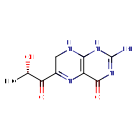
Sepiapterin is an orally bioavailable synthetic precursor to tetrahydrobiopterin (BH4) used to restore deficient endogenous BH4 levels and decrease phenylalanine levels in patients with phenylketonuria. It is a natural precursor of the enzymatic co-factor tetrahydrobiopterin (BH4), which activates PAH and helps reduce blood phenylalanine levels by enhancing the conformational stability of misfolded PAH enzymes and increasing intracellular concentrations of BH4.
- Mechanism
- Curator reviewed · 5 references
Phenylketonuria (PKU) is an inherited metabolic disorder characterized by reduced functionality of phenylalanine hydroxylase (PAH), an enzyme responsible for converting phenylalanine (Phe) to tyrosine. This deficiency leads to elevated blood Phe levels, which can result in neurocognitive deficits.
Sepiapterin is a natural precursor of the enzymatic co-factor tetrahydrobiopterin (BH4), which is critical for PAH function. Sepiapterin acts as a dual pharmacological chaperone, binding to variant PAH (including BH4-insensitive variants) to improve enzyme activity and increase intracellular BH4 concentrations. This mechanism effectively reduces blood Phe levels by enhancing the conformational stability of misfolded PAH enzyme and increasing BH4 concentrations.
- Primary indication
- Sepiapterin is indicated in conjunction with a phenylalanine-restricted diet for the treatment of hyperphenylalaninemia (HPA) in adult and pediatric patients 1 month of age and older with sepiapterin-responsive phenylketonuria (PKU).Curator reviewed · 1 structured indication
- Formula / weight
- C9H11N5O3 · 237.219 g/mol (avg)
- First approval
- Canada, 2025 · United States, 2025 · European Union, 2025
- Also known as
- L-sepiapterin · Sepiapterine
- Brand names
Resolves to
VPVOXUSPXFPWBN-VKHMYHEASA-NSMILESC[C@H](O)C(=O)C1=NC2=C(NC1)NC(N)=NC2=OWhat you can answer from here — as of September 23, 2026
Which drugs share a target with Sepiapterin, and which of those have an active Phase 3 trial?
Create a free account or log in to explore the full data card.
Create Account