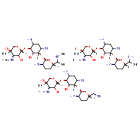
Gentamicin is an aminoglycoside used to treat a wide variety of aerobic infections in the body. Gentamicin is a bactericidal aminoglycoside that was discovered and isolated from Micromonospora purpurea in 1963.
- Mechanism
- Curator reviewed · 24 references
There are 3 key phases of aminoglycoside entry into cells. The first “ionic binding phase” occurs when polycationic aminoglycosides bind electrostatically to negatively charged components of bacterial cell membranes including with lipopolysaccharides and phospholipids within the outer membrane of Gram-negative bacteria and to teichoic acids and phospholipids within the cell membrane of Gram-positive bacteria. This binding results in displacement of divalent cations and increased membrane permeability, allowing for aminoglycoside entry. The second “energy-dependent phase I” of aminoglycoside entry into the cytoplasm relies on the proton-motive force and allows a limited amount of aminoglycoside access to its primary intracellular target - the bacterial 30S ribosome. This ultimately results in the mistranslation of proteins and disruption of the cytoplasmic membrane. Finally, in the “energy-dependent phase II” stage, concentration-dependent bacterial killing is observed. Aminoglycoside rapidly accumulates in the cell due to the damaged cytoplasmic membrane, and protein mistranslation and synthesis inhibition is amplified. The necessity of oxygen-dependent active transport explains why aminoglycosides are ineffective against anaerobic bacteria. Hence, aminoglycosides have both immediate bactericidal effects through membrane disruption and delayed bactericidal effects through impaired protein synthesis; observed experimental data and mathematical modeling support this two-mechanism model. Inhibition of protein synthesis is a key component of aminoglycoside efficacy. Structural and cell biological studies suggest that aminoglycosides bind to the 16S rRNA in helix 44 (h44), near the A site of the 30S ribosomal subunit, altering interactions between h44 and h45. This binding also displaces two important residues, A1492 and A1493, from h44, mimicking normal conformational changes that occur with successful codon-anticodon pairing in the A site. Overall, aminoglycoside binding has several negative effects including inhibition of translation, initiation, elongation, and ribosome recycling. Recent evidence suggests that the latter effect is due to a cryptic second binding site situated in h69 of the 23S rRNA of the 50S ribosomal subunit. Also, by stabilizing a conformation that mimics correct codon-anticodon pairing, aminoglycosides promote error-prone translation. Mistranslated proteins can incorporate into the cell membrane, inducing the damage discussed above.
- Formula / weight
- C60H123N15O21 · 1390.728 g/mol (avg)
- First approval
- Canada, 1998 · United States, 1982
- Also known as
- gentamycin
- Brand names
Resolves to
NPEFREDMMVQEPL-RWPARATISA-NSMILES[H][C@@]1(CN)CC[C@@H](N)[C@@H](O[C@]2([H])[C@@H](N)C[C@@H](N)[C@H](O[C@@]3([H])OC[C@](C)(O)[C@H](NC)[C@H]3O)[C@H]2O)O1.[H][C@]1(CC[C@@H](N)[C@@H](O[C@]2([H])[C@@H](N)C[C@@H](N)[C@H](O[C@@]3([H])OC[C@](C)(O)[C@H](NC)[C@H]3O)[C@H]2O)O1)C(C)N.[H][C@]1(CC[C@@H](N)[C@@H](O[C@]2([H])[C@@H](N)C[C@@H](N)[C@H](O[C@@]3([H])OC[C@](C)(O)[C@H](NC)[C@H]3O)[C@H]2O)O1)C(C)NCWhat you can answer from here — as of August 31, 2026
Which drugs share a target with Gentamicin, and which of those have an active Phase 3 trial?
Create a free account or log in to explore the full data card.
Create Account