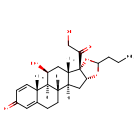
Budesonide is a corticosteroid used to treat Crohn's disease, asthma, COPD, hay fever and allergies, and ulcerative colitis. Budesonide was granted FDA approval on 14 February 1994.
- Mechanism
- Curator reviewed · 5 references
The short term effects of corticosteroids are decreased vasodilation and permeability of capillaries, as well as decreased leukocyte migration to sites of inflammation. Corticosteroids binding to the glucocorticoid receptor mediates changes in gene expression that lead to multiple downstream effects over hours to days.
Glucocorticoids inhibit neutrophil apoptosis and demargination; they inhibit phospholipase A2, which decreases the formation of arachidonic acid derivatives; they inhibit NF-Kappa B and other inflammatory transcription factors; they promote anti-inflammatory genes like interleukin-10.
Lower doses of corticosteroids provide an anti-inflammatory effect, while higher doses are immunosuppressive. High doses of glucocorticoids for an extended period bind to the mineralocorticoid receptor, raising sodium levels and decreasing potassium levels.
- Primary indication
- Budesonide extended-release capsules are indicated for the treatment and maintenance of mild to moderate Crohn’s disease.Curator reviewed · 28 structured indications
- Formula / weight
- C25H34O6 · 430.5339 g/mol (avg)
- First approval
- Canada, 2000 · United States, 1994 · European Union, 2020
- Code names
- MAP-0010 · S-1320
- Brand names
Resolves to
VOVIALXJUBGFJZ-KWVAZRHASA-NSMILES[H][C@@]12C[C@H]3OC(CCC)O[C@@]3(C(=O)CO)[C@@]1(C)C[C@H](O)[C@@]1([H])[C@@]2([H])CCC2=CC(=O)C=C[C@]12CWhat you can answer from here — as of September 23, 2026
Which drugs share a target with Budesonide, and which of those have an active Phase 3 trial?
Create a free account or log in to explore the full data card.
Create Account