Terazosin is an alpha-1 adrenergic antagonist used in the treatment of symptomatic benign prostatic hyperplasia and management of hypertension. Terazosin blocks adrenaline's action on alpha-1 adrenergic receptors, causing relaxation of smooth muscle in blood vessels and the prostate.
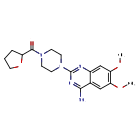
- Mechanism
- Curator reviewed · 11 references
Terazosin is selective for alpha-1-adrenoceptors but not their individual subtypes. Inhibition of these alpha-1-adrenoceptors results in relaxation of smooth muscle in blood vessels and the prostate, lowering blood pressure and improving urinary flow. Smooth muscle cells accounts for roughly 40% of the volume of the prostate and so their relaxation reduces pressure on the urethra.
It has also been shown that catecholamines induce factors responsible for mitogenesis and alpha-1-adrenergic receptor blockers inhibit this effect.
A final long term mechanism of terazosin and other alpha-1-adrenergic receptor blockers is the induction of apoptosis of prostate cells. Treatment with terazosin enhances the expression of transforming growth factor beta-1 (TGF-beta1), which upregulates p27kip1, and the caspase cascade.
- Primary indication
- Terazosin is indicated for use in treating symptomatic benign prostatic hyperplasia and hypertension.Curator reviewed · 4 structured indications
- Formula / weight
- C19H25N5O4 · 387.4329 g/mol (avg)
- First approval
- Canada, 1998 · United States, 1987
- Also known as
- Terazosine
- Code names
- Abbott 45975
- Brand names
Resolves to
VCKUSRYTPJJLNI-UHFFFAOYSA-NSMILESCOC1=C(OC)C=C2C(N)=NC(=NC2=C1)N1CCN(CC1)C(=O)C1CCCO1What you can answer from here — as of October 20, 2026
Which drugs share a target with Terazosin, and which of those have an active Phase 3 trial?
Create a free account or log in to explore the full data card.
Create Account