Mitoquinone is based on a novel technology, targeted lipophilic cations, that transport and concentrate antioxidants into the mitochondria -- organelles inside cells that provide energy for life processes -- where... In 2004, a genomic study of hereditary early-onset Parkinson's disease demonstrated a direct molecular link between mitochondrial dysfunction and the pathogenesis of Parkinson's disease.
- Mechanism
- Curator reviewed
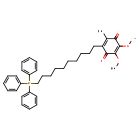
Mitoquinone is targeted to mitochondria by covalent attachment to a lipophilic triphenylphosphonium cation. Because of the large mitochondria membrane potential, the cations accumulate within cellular mitochondria up to 1,000 fold, compared to non-targeted antioxidants such as Coenzyme Q or its analogues, enabling the antioxidant moiety to block lipid peroxidation and protect mitochondria from oxidative damage. By selectively blocking mitochondrial oxidative damage, it prevents cell death.
- Primary indication
- Investigated for use/treatment in hepatitis (viral, C) and parkinson's disease.Curator reviewed
- Formula / weight
- C37H44O4P · 583.728 g/mol (avg)
- Also known as
- Mitoquinone cation · Mitoquinone ion
Resolves to
OIIMUKXVVLRCAF-UHFFFAOYSA-NSMILESCOC1=C(OC)C(=O)C(CCCCCCCCCC[P+](C2=CC=CC=C2)(C2=CC=CC=C2)C2=CC=CC=C2)=C(C)C1=OWhat you can answer from here — as of October 01, 2026
Which drugs share a target with Mitoquinone, and which of those have an active Phase 3 trial?
Create a free account or log in to explore the full data card.
Create Account