Acetazolamide is a carbonic anhydrase inhibitor used to treat edema from heart failure or medications, certain types of epilepsy, and glaucoma. One of the carbonic anhydrase inhibitors that is sometimes effective against absence seizures.
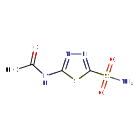
- Mechanism
- Curator reviewed
The anticonvulsant activity of Acetazolamide may depend on a direct inhibition of carbonic anhydrase in the CNS, which decreases carbon dioxide tension in the pulmonary alveoli, thus increasing arterial oxygen tension. The diuretic effect depends on the inhibition of carbonic anhydrase, causing a reduction in the availability of hydrogen ions for active transport in the renal tubule lumen. This leads to alkaline urine and an increase in the excretion of bicarbonate, sodium, potassium, and water.
- Primary indication
- For adjunctive treatment of: edema due to congestive heart failure; drug-induced edema; centrencephalic epilepsies; chronic simple (open-angle) glaucomaCurator reviewed · 13 structured indications
- Formula / weight
- C4H6N4O3S2 · 222.245 g/mol (avg)
- First approval
- Canada, 1998 · United States, 1978
- Also known as
- AZM
- Code names
- L 579486 · NSC-145177 · RP 5172
Resolves to
BZKPWHYZMXOIDC-UHFFFAOYSA-NSMILESCC(=O)NC1=NN=C(S1)S(N)(=O)=OWhat you can answer from here — as of September 23, 2026
Which drugs share a target with Acetazolamide, and which of those have an active Phase 3 trial?
Create a free account or log in to explore the full data card.
Create Account