Dihydroergotamine is an ergot alkaloid used in the acute treatment of migraine headache and cluster headache. A 9,10alpha-dihydro derivative of ergotamine.
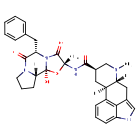
- Mechanism
- Curator reviewed · 4 references
DHE has several proposed mechanisms which may contribute to its therapeutic efficacy as an abortive therapy in migraines. Firstly, DHE's s agonist action on 5-hydroxytryptamine (5HT) 1b receptors in the smooth muscle of the cranial vasculature may provide relief via vasoconstriction of the blood vessels which typically become dilated due to the release of CGRP during migraine attacks. DHE's off-target action at alpha-adrenergic receptors may further contribute via this mechanism. The remaining mechanisms are thought to provide relief through the effects on the neurogenic causes of migraine symptoms. Agonist action by DHE on 5-HT1b and 5-HT1d receptors inhibits nociceptive signalling through the ventroposteromedial thalamus to the trigeminal sensory neurons. Further action on 5-HT1b and 5-HT1d receptors with the addition of agonist activity on 5-HT1f in the trigeminal nucleus caudalis decreases afferent signalling to trigeminal sensory neurons which contributes to central sensitization. The success of experimental compounds selectively targetting the 5-HT1f receptor lends support to this mechanism. Lastly, action at 5-HT1d receptors on trigeminal nerve terminals inhibits the release of vasoactive neuropeptides thought to contribute to pain and inflammation during a migraine attack. DHE is known to have 10-fold less potency at the 5-HT1b receptor than its predecessor ergotamine which reduces the incidence of vascular side effects. Notably, DHE slowly diffuses from receptors resulting in unreliable prediction of effects from plasma concentration.
- Primary indication
- Dihydroergotamine (DHE) in all formulations is indicated for the acute treatment of migraine with or without aura in adults.Curator reviewed · 2 structured indications
- Formula / weight
- C33H37N5O5 · 583.6774 g/mol (avg)
- First approval
- Canada, 2000 · United States, 1997
- Also known as
- 9,10-dihydroergotamine
- Code names
- MAP-0004
- Brand names
Resolves to
LUZRJRNZXALNLM-JGRZULCMSA-NSMILES[H][C@@]12CCCN1C(=O)[C@H](CC1=CC=CC=C1)N1C(=O)[C@](C)(NC(=O)[C@H]3CN(C)[C@]4([H])CC5=CNC6=CC=CC(=C56)[C@@]4([H])C3)O[C@@]21OWhat you can answer from here — as of September 23, 2026
Which drugs share a target with Dihydroergotamine, and which of those have an active Phase 3 trial?
Create a free account or log in to explore the full data card.
Create Account