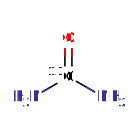
Urea C-13 is a diagnostic agent used for the detection of urease associated with Helicobacter pylori in the human stomach and initial diagnosis or post-treatment monitoring of Helicobacter pylori infection in adults. Urea 13C is a urea molecule radiolabelled with the non-radioactive element carbon-13.
- Mechanism
- Curator reviewed
The Urea Breath Test is based on the ability of the H. pylori enzyme urease to cleave urea into ammonia and carbon dioxide. As the urease enzyme is not present in mammalian cells, the presence of urease (and the products of urea cleavage) in the stomach is evidence that H. pylori bacteria are present. To detect H. pylori, urea labeled with 13C is swallowed by the patient. If gastric urease from H. pylori is present, urea is split to form CO2 and NH3 at the interface between the gastric epithelium and lumen and 13CO2 is absorbed into the blood and exhaled in the breath. Exhaled breath samples can then be collected and measured for the presence of radioactivity.
- Primary indication
- Urea-13C is indicated for use in the qualitative detection of urease associated with Helicobacter pylori in the human stomach and as an aid in the initial diagnosis and post-treatment monitoring of Helicobacter pylori infection in...Curator reviewed · 3 structured indications
- Formula / weight
- CH4N2O · 61.048 g/mol (avg)
- First approval
- United States, 2001 · European Union, 2016
- Also known as
- (13C)urea · 13C-urea · Carbon 13 urea · Carbon-13 urea · Urea (13C)
- Code names
- Urea C-13
- Brand names
Resolves to
XSQUKJJJFZCRTK-OUBTZVSYSA-NSMILESN[13C](N)=OWhat you can answer from here — as of September 23, 2026
Which other approved drugs treat the same conditions as Urea C-13, and which companies have late-stage candidates in those indications?
Create a free account or log in to explore the full data card.
Create Account