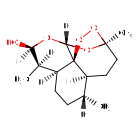
Artenimol is an artemisinin derivative and antimalarial agent used in the treatment of uncomplicated Plasmodium falciparum infections [FDA Label]. It was first authorized for market by the European Medicines Agency... It was first authorized for market by the European Medicines Agency in October 2011 in combination with DB13941 as the product Eurartesim.
- Mechanism
- Curator reviewed · 12 references
Artemisinins, including Artenimol which is a major active metabolite of many artemisinins, are thought to act via a common mechanism. While the exact mechanism of action is not certain, theories exist as to how artemisinins produce their antimalarial effect.
Artemisinins are believed to bind to haem within the P. falciparum parasite. The source of this haem varies with the life stage of the parasite. When the parasite is in the early ring stage artemisinins are believed to bind haem produced by the parasite's haem biosynthesis pathway. In later stages artemisinins likely bind to haem released by haemoglobin digestion. Once bound to haem, artemisinins are thought to undergo activation involving ferrous iron via reductive scission which splits the endoperoxide bridge to produce a reactive oxygen. This reactive oxygen is thought to undergo a subsequent intramolecular hydrogen abstraction to produce a reactive carbon radical. The carbon radical is believed to be the source of the drugs potent activity against P. falciparum by alkylating a wide array of protein targets. The nature and magnitude of the effect on specific protein function as a result of this alkylation is unknown.
One target which has been the focus of research is the sarco/endoplasmic reticulum Ca2+ ATPase pump of P. falciparum. Artemisinins have been found to irreversably bind to and inhibit this protein at a binding site similar to that of Thapsigargin. The mechanism is likely the same as for other proteins, namely alkylation via the carbon radical intermediate.
Artemisinins appear to preferentially collect in infected erythrocytes, concentrating the drug by several hundred-fold compared to uninfected cells. This may play a role in why little alkylation is seen in uninfected erythrocytes.
- Primary indication
- For the treatment of uncomplicated Plasmodium falciparum infection in adults, children, and infants aged 6 months and up weighing over 5 kg.Curator reviewed · 1 structured indication
- Formula / weight
- C15H24O5 · 284.352 g/mol (avg)
- First approval
- European Union, 2021
- Also known as
- beta-Dihydroartemisinin · Dihydroartemisinin · Dihydroartemisinine
- Code names
- GNF-PF-5634
- Brand names
Resolves to
BJDCWCLMFKKGEE-ISOSDAIHSA-NSMILES[H][C@@]12CC[C@@H](C)[C@]3([H])CC[C@@]4(C)OO[C@@]13[C@]([H])(O[C@H](O)[C@@H]2C)O4What you can answer from here — as of September 23, 2026
Which drugs share a target with Artenimol, and which of those have an active Phase 3 trial?
Create a free account or log in to explore the full data card.
Create Account