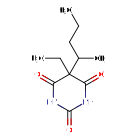
Pentobarbital is a barbiturate drug used to induce sleep, cause sedation, and control certain types of seizures. A short-acting barbiturate that is effective as a sedative and hypnotic (but not as an anti-anxiety) agent and is usually given orally.
- Mechanism
- Curator reviewed
Pentobarbital binds at a distinct binding site associated with a Cl- ionopore at the GABAA receptor, increasing the duration of time for which the Cl- ionopore is open. The post-synaptic inhibitory effect of GABA in the thalamus is, therefore, prolonged. All of these effects are associated with marked decreases in GABA-sensitive neuronal calcium conductance (gCa). The net result of barbiturate action is acute potentiation of inhibitory GABAergic tone. Barbiturates also act through potent (if less well characterized) and direct inhibition of excitatory AMPA-type glutamate receptors, resulting in a profound suppression of glutamatergic neurotransmission.
- Primary indication
- For the short-term treatment of insomnia.Curator reviewed · 4 structured indications
- Formula / weight
- C11H18N2O3 · 226.2722 g/mol (avg)
- First approval
- Canada, 1997 · United States, 1973
- Also known as
- Pentobarbitone
Resolves to
WEXRUCMBJFQVBZ-UHFFFAOYSA-NSMILESCCCC(C)C1(CC)C(=O)NC(=O)NC1=OWhat you can answer from here — as of September 23, 2026
Which drugs share a target with Pentobarbital, and which of those have an active Phase 3 trial?
Create a free account or log in to explore the full data card.
Create Account