Risperidone is a second-generation antipsychotic medication used to treat a number of mental health disorders including schizophrenia, bipolar mania, psychosis, or as an adjunct in severe depression. It is one of the most widely used SGAs.
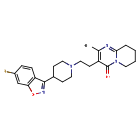
- Mechanism
- Curator reviewed · 15 references
Though its precise mechanism of action is not fully understood, current focus is on the ability of risperidone to inhibit the D2 dopaminergic receptors and 5-HT2A serotonergic receptors in the brain. Schizophrenia is thought to result from an excess of dopaminergic D2 and serotonergic 5-HT2A activity, resulting in overactivity of central mesolimbic pathways and mesocortical pathways, respectively.
D2 dopaminergic receptors are transiently inhibited by risperidone, reducing dopaminergic neurotransmission, therefore decreasing positive symptoms of schizophrenia, such as delusions and hallucinations. Risperidone binds transiently and with loose affinity to the dopaminergic D2 receptor, with an ideal receptor occupancy of 60-70% for optimal effect. Rapid dissociation of risperidone from the D2 receptors contributes to decreased risk of extrapyramidal symptoms (EPS), which occur with permanent and high occupancy blockade of D2 dopaminergic receptors. Low-affinity binding and rapid dissociation from the D2 receptor distinguish risperidone from the traditional antipsychotic drugs. A higher occupancy rate of D2 receptors is said to increase the risk of extrapyramidal symptoms and is therefore to be avoided.
Increased serotonergic mesocortical activity in schizophrenia results in negative symptoms, such as depression and decreased motivation. The high-affinity binding of risperidone to 5-HT2A receptors leads to a decrease in serotonergic activity. In addition, 5-HT2A receptor blockade results in decreased risk of extrapyramidal symptoms, likely by increasing dopamine release from the frontal cortex, and not the nigrostriatal tract. Dopamine level is therefore not completely inhibited. Through the above mechanisms, both serotonergic and D2 blockade by risperidone are thought to synergistically work to decrease the risk of extrapyramidal symptoms.
Risperidone has also been said to be an antagonist of alpha-1 (α1), alpha-2 (α2), and histamine (H1) receptors. Blockade of these receptors is thought to improve symptoms of schizophrenia, however the exact mechanism of action on these receptors is not fully understood at this time.
- Primary indication
- Risperidone is indicated for the treatment of schizophrenia and irritability associated with autistic disorder.Curator reviewed · 15 structured indications
- Formula / weight
- C23H27FN4O2 · 410.4845 g/mol (avg)
- First approval
- Canada, 1998 · United States, 1993 · European Union, 2022
- Code names
- R-64,766 · RCN-3028
- Brand names
Resolves to
RAPZEAPATHNIPO-UHFFFAOYSA-NSMILESCC1=C(CCN2CCC(CC2)C2=NOC3=C2C=CC(F)=C3)C(=O)N2CCCCC2=N1What you can answer from here — as of September 23, 2026
Which drugs share a target with Risperidone, and which of those have an active Phase 3 trial?
Create a free account or log in to explore the full data card.
Create Account