Levodopa is a dopamine precursor used in the management of Parkinson's disease, often in combination with carbidopa, as well as other conditions associated with parkinsonism. Levodopa is a prodrug of dopamine that is administered to patients with Parkinson's due to its ability to cross the blood-brain barrier.
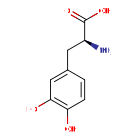
- Mechanism
- Curator reviewed
Levodopa by various routes crosses the blood brain barrier, is decarboxylated to form dopamine. This supplemental dopamine performs the role that endogenous dopamine cannot due to a decrease of natural concentrations and stimulates dopaminergic receptors.
- Primary indication
- Levodopa on its own is formulated as an oral inhalation powder indicated for intermittent treatment of off episodes in Parkinson's patients who are already being treated with carbidopa and levodopa.Curator reviewed · 9 structured indications
- Formula / weight
- C9H11NO4 · 197.1879 g/mol (avg)
- First approval
- Canada, 2002 · United States, 1975 · European Union, 2016
- Also known as
- Dihydroxy-L-phenylalanine · L-DOPA · LDOPA · Levo-dopa
- Code names
- CVT-301 · V-1512
- Brand names
Resolves to
WTDRDQBEARUVNC-LURJTMIESA-NSMILESN[C@@H](CC1=CC(O)=C(O)C=C1)C(O)=OWhat you can answer from here — as of September 23, 2026
Which drugs share a target with Levodopa, and which of those have an active Phase 3 trial?
Create a free account or log in to explore the full data card.
Create Account