An alkaloid found in the roots of Rauwolfia serpentina and R. vomitoria. Reserpine inhibits the uptake of norepinephrine into storage vesicles resulting in depletion of catecholamines and serotonin from central... It has been used as an antihypertensive and an antipsychotic as well as a research tool, but its adverse effects limit its clinical use.
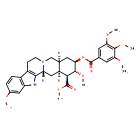
- Mechanism
- Curator reviewed
Reserpine's mechanism of action is through inhibition of the ATP/Mg2+ pump responsible for the sequestering of neurotransmitters into storage vesicles located in the presynaptic neuron. The neurotransmitters that are not sequestered in the storage vesicle are readily metabolized by monoamine oxidase (MAO) causing a reduction in catecholamines.
- Primary indication
- For the treatment of hypertensionCurator reviewed · 1 structured indication
- Formula / weight
- C33H40N2O9 · 608.6787 g/mol (avg)
- First approval
- Canada, 1997 · United States, 1960
- Also known as
- Reserpin
- Code names
- ENT-50146 · NSC-237659 · NSC-59272
- Brand names
Resolves to
QEVHRUUCFGRFIF-MDEJGZGSSA-NSMILES[H][C@]12C[C@@H](OC(=O)C3=CC(OC)=C(OC)C(OC)=C3)[C@H](OC)[C@@H](C(=O)OC)[C@@]1([H])C[C@@]1([H])N(CCC3=C1NC1=C3C=CC(OC)=C1)C2What you can answer from here — as of September 23, 2026
Which drugs share a target with Reserpine, and which of those have an active Phase 3 trial?
Create a free account or log in to explore the full data card.
Create Account