Lidocaine is a local anesthetic used in a wide variety of superficial and invasive procedures. Ever since its discovery and availability for sale and use in the late 1940s, lidocaine has become an exceptionally commonly used medication.
- Mechanism
- Curator reviewed · 30 references
Lidocaine is a local anesthetic of the amide type. It is used to provide local anesthesia by nerve blockade at various sites in the body. It does so by stabilizing the neuronal membrane by inhibiting the ionic fluxes required for the initiation and conduction of impulses, thereby effecting local anesthetic action. In particular, the lidocaine agent acts on sodium ion channels located on the internal surface of nerve cell membranes. At these channels, neutral uncharged lidocaine molecules diffuse through neural sheaths into the axoplasm where they are subsequently ionized by joining with hydrogen ions. The resultant lidocaine cations are then capable of reversibly binding the sodium channels from the inside, keeping them locked in an open state that prevents nerve depolarization. As a result, with sufficient blockage, the membrane of the postsynaptic neuron will ultimately not depolarize and will thus fail to transmit an action potential. This facilitates an anesthetic effect by not merely preventing pain signals from propagating to the brain but by aborting their generation in the first place.
In addition to blocking conduction in nerve axons in the peripheral nervous system, lidocaine has important effects on the central nervous system and cardiovascular system. After absorption, lidocaine may cause stimulation of the CNS followed by depression and in the cardiovascular system, it acts primarily on the myocardium where it may produce decreases in electrical excitability, conduction rate, and force of contraction.
- Primary indication
- Lidocaine is an anesthetic of the amide group indicated for production of local or regional anesthesia by infiltration techniques such as percutaneous injection and intravenous regional anesthesia by peripheral nerve block techniques such as brachial...Curator reviewed · 62 structured indications
- Formula / weight
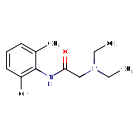
- C14H22N2O · 234.3373 g/mol (avg)
- First approval
- Canada, 1996 · United States, 1948 · European Union, 2016
- Also known as
- Lignocaine
- Code names
- ALGRX-3268 · LSM-3165 · NSC-40030
- Brand names
Resolves to
NNJVILVZKWQKPM-UHFFFAOYSA-NSMILESCCN(CC)CC(=O)NC1=C(C)C=CC=C1CWhat you can answer from here — as of September 23, 2026
Which drugs share a target with Lidocaine, and which of those have an active Phase 3 trial?
Create a free account or log in to explore the full data card.
Create Account