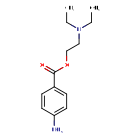
Procaine is a local anesthetic used for anesthesia, peripheral nerve block, and spinal nerve block. A local anesthetic of the ester type that has a slow onset and a short duration of action.
- Mechanism
- Curator reviewed
Procaine acts mainly by inhibiting sodium influx through voltage gated sodium channels in the neuronal cell membrane of peripheral nerves. When the influx of sodium is interrupted, an action potential cannot arise and signal conduction is thus inhibited. The receptor site is thought to be located at the cytoplasmic (inner) portion of the sodium channel. Procaine has also been shown to bind or antagonize the function of N-methyl-D-aspartate (NMDA) receptors as well as nicotinic acetylcholine receptors and the serotonin receptor-ion channel complex.
- Primary indication
- Used as a local anesthetic primarily in oral surgeryCurator reviewed · 7 structured indications
- Formula / weight
- C13H20N2O2 · 236.3101 g/mol (avg)
- First approval
- Canada, 2006 · United States, 2006
- Also known as
- Novocaine · Vitamin H3
- Brand names
Resolves to
MFDFERRIHVXMIY-UHFFFAOYSA-NSMILESCCN(CC)CCOC(=O)C1=CC=C(N)C=C1What you can answer from here — as of September 23, 2026
Which drugs share a target with Procaine, and which of those have an active Phase 3 trial?
Create a free account or log in to explore the full data card.
Create Account