Amphetamine is a CNS stimulant and sympathomimetic agent indicated for the treatment of Attention Deficit Hyperactivity Disorder (ADHD). Amphetamine, a compound discovered over 100 years ago, is one of the more restricted controlled drugs.
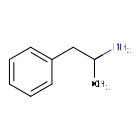
- Mechanism
- Curator reviewed · 11 references
Amphetamine's structure closely resembles catecholamine neurotransmitters, characterized primarily by a long planar conformation, an aromatic ring, and nitrogen in the aryl side chain. Like endogenous catecholamines, amphetamine is actively transported into presynaptic nerve terminals via monoamine reuptake transporters, which require association with two sodium ions and one chloride ion. Because amphetamine acts as a competitive substrate, increased concentrations lead to greater internalization of amphetamine. Once in the presynaptic terminal, amphetamine competes for storage in VMAT2 (Vesicular Monoamine Transporter 2), displacing other monoamines. This action induces the release of neurotransmitters into the synapse through a process known as reverse transport. The d-isomer is approximately fourfold more potent than the $l$-isomer in promoting dopamine release via this mechanism. The mechanism of action is further complemented by the inhibition of both monoamine reuptake and monoamine oxidase (MAO), which act synergistically to significantly elevate monoamine concentrations. Amphetamine does not act as a direct inhibitor but rather as a competitive substrate, classifying it as a weak dopamine reuptake inhibitor, a moderate noradrenaline reuptake inhibitor, and a very weak serotonin reuptake inhibitor. Consequently, the l-isomer exhibits significantly lower potency in this specific action. Amphetamine acts as a weak inhibitor of the mitochondrial-bound enzyme MAO, the catalytic enzyme responsible for degrading excess neurotransmitters. Although this mechanism is often considered minor due to its weak inhibitory nature, it remains a component of amphetamine's overall action.
Amphetamine is a modulator of glutamatergic neurotransmission, primarily via its action on the dopamine system. The mass release of dopamine caused by amphetamine subsequently signals to the glutamatergic system, leading to long-lasting changes in synaptic plasticity. Amphetamine's entry into dopamine neurons triggers the endocytosis of the excitatory amino acid transporter EAAT3, reducing glutamate clearance and potentiating excitatory synaptic responses mediated by ionotropic receptors. Chronic exposure also alters receptor composition, such as the downregulation of the NMDA receptor NR2B subunit in the striatum, which is a key molecular change underlying behavioral sensitization to the drug.
- Primary indication
- Amphetamine is indicated for the treatment of attention-deficit/hyperactivity disorders (ADHD) as well as for the treatment of central nervous system disorders such as narcolepsy.Curator reviewed · 13 structured indications
- Formula / weight
- C9H13N · 135.2062 g/mol (avg)
- First approval
- Canada, 2016 · United States, 1996
- Also known as
- alpha-Methylbenzeneethaneamine · Amfetamine · beta-Aminopropylbenzene · Desoxynorephedrine · rac-amphetamine
- Brand names
Resolves to
KWTSXDURSIMDCE-UHFFFAOYSA-NSMILESCC(N)CC1=CC=CC=C1What you can answer from here — as of October 27, 2026
Which drugs share a target with Amphetamine, and which of those have an active Phase 3 trial?
Create a free account or log in to explore the full data card.
Create Account