Troglitazone was withdrawn in 2000 due to risk of hepatotoxicity. It was superseded by pioglitazone and rosiglitazone.
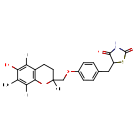
- Mechanism
- Curator reviewed
Troglitazone is a thiazolidinedione antidiabetic agent that lowers blood glucose by improving target cell response to insulin. It has a unique mechanism of action that is dependent on the presence of insulin for activity. Troglitazone decreases hepatic glucose output and increases insulin dependent glucose disposal in skeletal muscle. Its mechanism of action is thought to involve binding to nuclear receptors (PPAR) that regulate the transcription of a number of insulin responsive genes critical for the control of glucose and lipid metabolism. Troglitazone is a ligand to both PPARα and PPARγ, with a highter affinity for PPARγ. The drug also contains an α-tocopheroyl moiety, potentially giving it vitamin E-like activity. Troglitazone has been shown to reduce inflammation, and is associated with a decrase in nuclear factor kappa-B (NF-κB) and a concomitant increase in its inhibitor (IκB). Unlike sulfonylureas, troglitazone is not an insulin secretagogue.
- Primary indication
- For the treatment of Type II diabetes mellitus.Curator reviewed
- Formula / weight
- C24H27NO5S · 441.54 g/mol (avg)
Resolves to
GXPHKUHSUJUWKP-UHFFFAOYSA-NSMILESCC1=C(C)C2=C(CCC(C)(COC3=CC=C(CC4SC(=O)NC4=O)C=C3)O2)C(C)=C1OWhat you can answer from here — as of September 23, 2026
Which drugs share a target with Troglitazone, and which of those have an active Phase 3 trial?
Create a free account or log in to explore the full data card.
Create Account