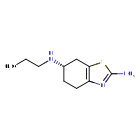
Pramipexole is a non-ergot dopamine agonist used to treat the signs and symptoms of idiopathic Parkinson's disease and Restless Legs Syndrome (RLS). It is a non-ergot dopamine agonist drug that is efficacious in treating various Parkinson's symptoms such as tremor, rigidity, and bradykinesia (slow movement).
- Mechanism
- Curator reviewed · 3 references
The exact mechanism of action of pramipexole as a treatment for Parkinson's disease is unknown at this time. It is thought, however, that the ability of pramipexole to cause stimulation of the dopamine receptors in the striatum of the brain, a region that receives a vast array of neurological input and is responsible for a wide variety of functions, may be involved. Studies performed in animals show that pramipexole influences striatal neuronal transmission rates following activation of dopamine receptors.
Pramipexole is considered a non-ergot dopamine agonist that shows specificity and strong activity at the D2 subfamily of dopamine receptors in vitro, binding selectively and dopamine D2 receptors and showing a preference for the dopamine D3 receptor subtype rather than other subtypes. The clinical significance of this binding specificity is unknown.
- Primary indication
- This drug is indicated for the symptomatic treatment of Parkinson’s disease.Curator reviewed · 3 structured indications
- Formula / weight
- C10H17N3S · 211.327 g/mol (avg)
- First approval
- Canada, 1998 · United States, 2003 · European Union, 2016
- Code names
- PNU 98528 · SND 919 Cl 2Y · SUD 919 CL 24 · U 98528 E
- Brand names
Resolves to
FASDKYOPVNHBLU-ZETCQYMHSA-NSMILESCCCN[C@H]1CCC2=C(C1)SC(N)=N2What you can answer from here — as of September 23, 2026
Which drugs share a target with Pramipexole, and which of those have an active Phase 3 trial?
Create a free account or log in to explore the full data card.
Create Account