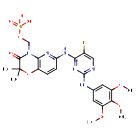
Fostamatinib is a spleen tyrosine kinase inhibitor used to treat chronic immune thrombocytopenia after attempting one other treatment. Fostamatinib has been investigated for the treatment and basic science of Rheumatoid Arthritis and Immune Thrombocytopenic Purpura (ITP).
- Mechanism
- Curator reviewed · 9 references
The active metabolite of fostamatinib, R406, is an inhibitor of spleen tyrosine kinase (Syk). It binds reversibly to the ATP binding pocket with high affinity (Ki = 30nM), inhibiting the kinase activity with an IC50 of 41nM.
Syk is a cytosolic protein kinase and part of the signalling cascade which occurs with Fc receptors, TCRs, and BCRs. It contains two src homology 2 (SH2) domains separated by a linker domain. These SH2 domains bind to tyrosine residues on the immunoreceptor tyrosine-based activating motif phosphorylated by Lyn, another kinase in the cascade. This motif is located on the cytoplasmic regions of several immune receptors including Fc receptors, TCRs, BCRs, and natural killer cell receptors. The flexibility provided by the linker enables the protein to bind to many receptor types. Inhibition of Syk suppresses downstream signal transduction.
While Syk plays a role in some pathways involved in the generation of the oxidative burst by neutrophils or phagocytosis by macrophages, R406 does not have a significant effect on these processes. This is likely due to redundant pathways which do not involve Syk. Similarly Syk does not produce significant effects on platelet activation despite its involvement in glycoprotein IV and integrin based signalling. Activation of antibody-dependent cell-mediated toxicity by natural killer cells is also unaffected despite the involvement of Syk in Fc receptor signalling.
R406 binds to the adenosine A3 receptor as an antagonist as well as the adenosine and monoamine uptake transporters as an inhibitor. It has also been found to be an inhibitor of UDP glucuronosyltransferase UGT1A1, phosphodiesterase PDE5, fatty acid amide hydrolase, 5-lipoxygenase, cathepsin L, and cathepsin S. R406 appears to inhibit a wide range of kinases at higher concentrations. It is thought that inhibition of some of these targets may be responsible for the increase in blood pressure seen with fostamatinib.
- Primary indication
- Fostamatinib is indicated for use in the treatment of chronic immune thrombocytopenia (ITP) in patients who have had insufficient response to previous therapy.Curator reviewed · 1 structured indication
- Formula / weight
- C23H26FN6O9P · 580.4595 g/mol (avg)
- First approval
- Canada, 2021 · United States, 2018 · European Union, 2020
- Code names
- R-788 FREE ACID · R-935788 · R-935788 FREE ACID
- Brand names
Resolves to
GKDRMWXFWHEQQT-UHFFFAOYSA-NSMILESCOC1=CC(NC2=NC=C(F)C(NC3=NC4=C(OC(C)(C)C(=O)N4COP(O)(O)=O)C=C3)=N2)=CC(OC)=C1OCWhat you can answer from here — as of September 23, 2026
Which drugs share a target with Fostamatinib, and which of those have an active Phase 3 trial?
Create a free account or log in to explore the full data card.
Create Account