Aripiprazole is an atypical antipsychotic used in the treatment of a wide variety of mood and psychotic disorders, such as schizophrenia, bipolar I, major depressive disorder, irritability associated with autism, and Tourette's syndrome. It is also indicated as an injection for agitation associated with schizophrenia or bipolar mania.
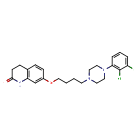
- Mechanism
- Curator reviewed · 7 references
The antipsychotic action of aripiprazole is likely due to its partial agonist activity on D2 and 5-HT1A receptors as well as its antagonist activity at 5-HT2A receptors; however, the exact mechanism has not been fully elucidated. One of the mechanisms that have been proposed is that aripiprazole both stimulates and inhibits dopamine as it engages the D2 receptor. It lowers dopamine neuronal firing at high dopamine concentrations and increases dopamine firing at low concentrations. Its partial agonist activity gives aripiprazole an intermediate level of dopaminergic neuronal tone between full agonist and antagonist of the D2 receptor. In addition, some adverse effects may be due to action on other receptors. For example, orthostatic hypotension may be explained by antagonism of the adrenergic alpha-1 receptors.
- Primary indication
- Aripiprazole is indicated for the treatment of acute manic and mixed episodes associated with bipolar I disorder, irritability associated with autism spectrum disorder, schizophrenia, and Tourette's disorder.Curator reviewed · 14 structured indications
- Formula / weight
- C23H27Cl2N3O2 · 448.385 g/mol (avg)
- First approval
- Canada, 2014 · United States, 2002 · European Union, 2016
- Code names
- OPC-14597 · OPC-31
- Brand names
Resolves to
CEUORZQYGODEFX-UHFFFAOYSA-NSMILESClC1=CC=CC(N2CCN(CCCCOC3=CC4=C(CCC(=O)N4)C=C3)CC2)=C1ClWhat you can answer from here — as of September 23, 2026
Which drugs share a target with Aripiprazole, and which of those have an active Phase 3 trial?
Create a free account or log in to explore the full data card.
Create Account