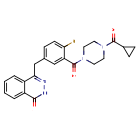
Olaparib is a poly (ADP-ribose) polymerase (PARP) inhibitor used to treat ovarian cancer, breast cancer, pancreatic cancer, and prostate cancer. PARP inhibitors represent a novel class of anti-cancer therapy and they work by taking advantage of a defect in DNA repair in cancer cells with BRCA mutations and inducing cell death.
- Mechanism
- Curator reviewed · 5 references
Poly(ADP-ribose) polymerases (PARPs) are multifunctional enzymes comprising 17 members. They are involved in essential cellular functions, such as DNA transcription and DNA repair. PARPs recognize and repair cellular DNA damage, such as single-strand breaks (SSBs) and double-strand breaks (DSBs). Different DNA repair pathways exist to repair these DNA damages, including the base excision repair (BER) pathway for SSBs and BRCA-dependent homologous recombination for DSBs.
Olaparib is a PARP inhibitor: while it acts on PARP1, PARP2, and PARP3, olaparib is a more selective competitive inhibitor of NAD+ at the catalytic site of PARP1 and PARP2. Inhibition of the BER pathway by olaparib leads to the accumulation of unrepaired SSBs, which leads to the formation of DSBs, which is the most toxic form of DNA damage. While BRCA-dependent homologous recombination can repair DSBs in normal cells, this repair pathway is defective in cells with BRCA1/2 mutations, such as certain tumour cells. Inhibition of PARP in cancer cells with BRCA mutations leads to genomic instability and apoptotic cell death. This end result is also referred to as synthetic lethality, a phenomenon where the combination of two defects - inhibition of PARP activity and loss of DSB repair by HR - that are otherwise benign when alone, lead to detrimental results.
In vitro studies have shown that olaparib-induced cytotoxicity may involve inhibition of PARP enzymatic activity and increased formation of PARP-DNA complexes, resulting in DNA damage and cancer cell death.
- Primary indication
- Ovarian cancer Olaparib is indicated for the maintenance treatment of adults with deleterious or suspected deleterious germline or somatic BRCA-mutated advanced epithelial ovarian, fallopian tube or primary peritoneal cancer who are in complete or partial...Curator reviewed · 35 structured indications
- Formula / weight
- C24H23FN4O3 · 434.4628 g/mol (avg)
- First approval
- Canada, 2016 · United States, 2014 · European Union, 2021
- Code names
- AZD-2281 · KU-0059436 · KU-59436 · MK-7339
- Brand names
Resolves to
FDLYAMZZIXQODN-UHFFFAOYSA-NSMILESFC1=CC=C(CC2=NNC(=O)C3=CC=CC=C23)C=C1C(=O)N1CCN(CC1)C(=O)C1CC1What you can answer from here — as of September 24, 2026
Which drugs share a target with Olaparib, and which of those have an active Phase 3 trial?
Create a free account or log in to explore the full data card.
Create Account