Pixantrone is an antineoplastic agent use to treat patients with relapsed or refractory aggressive Non-Hodgkin B-cell Lymphomas (NHL). Pixantrone is an aza-anthracenedione and DNA intercalator which inhibits topoisomerase II.
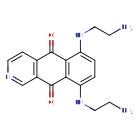
- Mechanism
- Curator reviewed
Pixantrone is an aza-anthracenedione which acts as a DNA intercalator. By intercalating between DNA, with modest affinity, it stimulates DNA cleavage by topoisomerase II. (Pixantrone acts as a poison to topoisomerase II by stabilizing protein-DNA complexes which are usually transient, giving rise to double stranded DNA breaks.) However, pixantrone is believed to have additional mechanisms of action as its potency does not correlate to the degree of double stranded DNA breaks observed. It has been postulated that this second mechanism may be pixantrone-DNA adduct formation.
It is important to note that the formation of a pixtantrone-DNA adduct requires pixantrone activation by formaldehyde. Formadehyde may be generated in vitro by hydrogen peroxide, and is derived by various sources in biological systems. It is present in low levels as a result of normal metabolism, and may be present in elevated levels in some haematolgical malignancies. The formation of pixantrone-DNA adducts is thus feasible, and it is believed that a long pixantrone-DNA adduct half life has the potential to maximize DNA damage. It may do so by enhancing the disruption of DNA replication and transcription, and potentially by encourage apoptosis.
In explanation of pixantrones lack of cardiotoxicity, it has been elucidated that pixantrone is structurally similar to mitoxantrone; however, instead of a 5,8-dihydroxyphenyl ring (thought to be responsible for cardiotoxicity) it has a nitrogen heteroatom. This nitrogen heteroatom helps to create additional hydrogen bonding sites amd increases pixantrone interaction with DNA and topoisomerase II.
Pixantrone's lack of a hydroquinone is believed to render it resistant to one electron reduction. In contrast, doxorubicin - which contains a hydroquinone - experiences one electron redox cycling and ROS formation via NADH dehydrogenase. Pixantrone also does not bind iron, and thus does not produce ROS by redox cycling between oxidative states of iron, as other anthracyclines do.
The first line agent doxorubicin is cardiotoxic, in part, due to its ability to redox activate the superoxide anion and hydrogen peroxide, and form a long-lived secondary alcohol metabolite: doxorubicinol. Clearance of doxorubicin from myocardial tissue is incomplete, and it can be found months or years after the last administration. In doxorubicin treated ex vivo cardiac strips, pixantrone formed an N-dealkylated product that inhibited metabolism of residual doxorubicin into doxorubicinol. Additionally, in ex vivo human myocardial strips (doxorubicin naive, and doxorubicin pretreated) pixantrone showed high cardiac uptake without formation of superoxide anion or hydrogen peroxide. Pixantrones lack of cardiotoxicity is thus attributed to its redox inactivity and inhibition of doxorubicinol formation.
- Primary indication
- Currently in Phase III investigation for treatment of relapsed or refractory aggressive non-Hodgkin's lymphoma in patients who have failed two prior lines of therapy.Curator reviewed · 2 structured indications
- Formula / weight
- C17H19N5O2 · 325.372 g/mol (avg)
- Code names
- BBR-2778
Resolves to
PEZPMAYDXJQYRV-UHFFFAOYSA-NSMILESNCCNC1=CC=C(NCCN)C2=C1C(=O)C1=C(C=NC=C1)C2=OWhat you can answer from here — as of September 23, 2026
Which drugs share a target with Pixantrone, and which of those have an active Phase 3 trial?
Create a free account or log in to explore the full data card.
Create Account