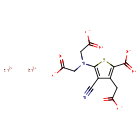
Strontium ranelate is a medication used for the management of severe osteoporosis in high-risk postmenopausal women and adult men. Some reports have shown that strontium ranelate can slow down the progression of osteoarthritis of the knee.
- Mechanism
- Curator reviewed · 8 references
The underlying pathogenesis of osteperosis involves an imbalance between bone resorption and bone formation. Osteoclasts are a kind of differentiated or specialized bone cell that breaks down bone tissue while osteoblasts are another set of differentiated bone cells that synthesize and rebuild bone tissue. When osteoclasts degrade bone tissue faster than the osteoblasts are capable of rebuilding the bone tissue, low or inadequate bone mass density and osteoperosis can resula One of the mechanisms with which strontium ranelate is thought to act is its functionality as an agonist of the extracellular calcium sensing receptors (CaSRs) of osteoblasts and osteoclasts. Ordinary interaction between calcium 2+ divalent cations with mature osteoclast CaSRs is known to induce osteoclast apoptosis. Subsequently, strontium 2+ divalent cations from strontium ranelate use can also bind CaSRs on osteoclasts to induce their apoptosis because of the strontium 2+ cation's close resemeblance to calcium 2+. Contact between extracelluar calcium 2+ and osteoclast CaSRs stimulates the phospholipase C (PLC) dependant breakdown of phosphatidylinositol 4,5-biphosphate (PIP2) into the two secondary messengers inositol 1,4,5-trisphosphate (IP3) and diacylglycerol (DAG). Whereas the calcium-CaSRs interaction then performs IP3 Adependent translocation of nuclear factor NF-kB from the cytoplasm to the nucleus in mature osteoclasts, strontium-CaSRs interactions involves a DAG-PKC beta II (protein kinase C beta II) signalling pathway for translocating NF-kB from the cytoplasm to the nucleus in an IP3-independent manner. Although the calcium 2+ and strontium 2+ mediated signalling pathways are different, both CaSR interactions induce osteoclast apoptosis and are in fact capable of potentiating each other, leading to enhanced osteoclast apoptosis and decreased bone tissue degradation.
At the same time, given the similarity between the calcium 2+ and strontium 2+ cations, strontium 2+ cations from strontium ranelate are seemingly also able to act as an agonist and stimulate the CaSRs on osteoblasts, possibly in tandem with various local osteoblast stimulatory growth factors like transforming growth factor β (TGF β) and/or bone morphogenetic proteins (BMPs), to stimulate cyclic D genes and early oncogenes like c-fos and egr-1 that can mediate the mitogenesis and proliferation of new or more osteoblasts. Moreover, although the involvement of the PLC mediated pathway may be a part of the signalling mechanism in osteoblasts following the stimulation of their CaSRs, this has not yet been fully elucidated.
Furthermore, strontium ranelate is also thought to be capable of stimulating osteoblasts to enhance the expression of osteoprotegerin while also concurrently reducing the expression of receptor activator of nuclear factor kappa-Β ligand (RANKL) in primary human osteoblastic cells. As osteoprotegerin can competitively bind to RANKL as a decoy receptor, which can prevent RANKL from binding to RANK, which is an activity that facilitates the signaling pathway for the differentiation and activaiton of osteoclasts. The subsequent net effect of these actions ultiamtely results in decreased osteoclastogenesis.
Moreover, bone biopsies obtained from patients treated with stronatium ranelate in clinical study reveal improvements in intrinsic bone tissue quality and microarchitecutre in ostepoerosis as evidenced by increased trabecular number, decreased trabecular separation, lower structure model index, and increased cortical thickness associated with a shift in trabecular structure from rod to plate like configurations compared with control patients.
Additionally, strontium from administered strontium ranelate is absorbed onto the crystal surface of treated bones and only slightly substitiutes for calcium in the apatite crystal of newly formed bone. As a result, there is an increased X-ray absorption of strontium as compared to calcium, which can lead to an amplification of bone mineral density (BMD) measurement by dual-proton X-ray absorptiometry. In essence, although strontium ranelate use can increase BMD some of the observations may be overestimations due to skeletal accretion of strontium in strontium ranelate treated patients.
Having the ability to both generate more osetoblasts and decrease the number of osteoclasts gives strontium ranelate an apparent dual mechanism of action when used to treat osteoperosis.
- Primary indication
- Strontium ranelate is therapeutically indicated for the treatment of severe osteoperosis in: a) postmenopasual women, and b) adult men, who are at high risk of fractures, for whom treatment with other medical products approved for...Curator reviewed · 1 structured indication
- Formula / weight
- C12H6N2O8SSr2 · 513.49 g/mol (avg)
Resolves to
XXUZFRDUEGQHOV-UHFFFAOYSA-JSMILES[Sr++].[Sr++].[O-]C(=O)CN(CC([O-])=O)C1=C(C#N)C(CC([O-])=O)=C(S1)C([O-])=OWhat you can answer from here — as of July 03, 2026
Which drugs share a target with Strontium ranelate, and which of those have an active Phase 3 trial?
Create a free account or log in to explore the full data card.
Create Account