Temoporfin is a photosensitizer used to treat squamous cell carcinomas of the head and neck. It was first authorized for market by the European Medicines Agency in October 2001.
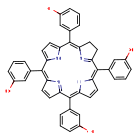
- Mechanism
- Curator reviewed · 4 references
Temoporfin is excited from ground state to the first excited singlet state by the application of 652 nm light. It is then thought to undergo intersystem crossing to an excited triplet state which is longer lived and able to interact with surrounding molecules. It is then thought to produce cytotoxic species by either a Type I or Type II reaction typical of agents used in photodynamic therapy. Type I involves either hydrogen abstraction of electron transfer from the excited photosensitizer to a substrate molecule to produce free radicals or radical ions. Type II reactions involve a similar reaction with oxygen as the substrate to produce reactive oxygen species. These reactive products cause oxidative damage to the cancer cell resulting in cell death.
There is evidence that photodynamic therapy with Temoporfin activates macrophages and increases phagocytosis. These activated macrophages also produce more tumour necrosis factor-α (TNF-α) and nitric oxide (NO). It is thought that this increase in macrophage activity contributes to the efficacy of therapy through phagocytosis of cancer cells and increased cell death signalling though TNF-α. The increase in NO production likely contributes to oxidative damage through reactive nitrogen species.
- Primary indication
- For use in the treatment of patients with advanced squamous cell carcinoma of the head and neck failing standard therapies and who are unsuitable for radiotherapy, surgery, or systemic chemotherapy.Curator reviewed · 1 structured indication
- Formula / weight
- C44H32N4O4 · 680.764 g/mol (avg)
- First approval
- European Union, 2016
- Also known as
- m-THPC · meso-tetrahydroxyphenylchlorin
- Code names
- EF-9
- Brand names
Resolves to
LYPFDBRUNKHDGX-LWQDQPMZSA-NSMILESOC1=CC=CC(=C1)C-1=C2\CCC(=N2)\C(=C2/N\C(\C=C2)=C(/C2=N/C(/C=C2)=C(\C2=CC=C\-1N2)C1=CC(O)=CC=C1)C1=CC(O)=CC=C1)\C1=CC(O)=CC=C1What you can answer from here — as of July 18, 2026
Which other approved drugs treat the same conditions as Temoporfin, and which companies have late-stage candidates in those indications?
Create a free account or log in to explore the full data card.
Create Account