Galactose has been used in trials studying the treatment and diagnosis of Hepatitis C, Hepatic Cancer, Wilsons Disease, Diabetic Macular Oedema, and Focal Segmental Glomerulosclerosis, among others. There are even... There are even proposals for its use in accelerating senescence in mice, rats, and Drosophila, for its association with ovarian cancer, or even for the potential treatment of focal segmental glomerulosclerosis.
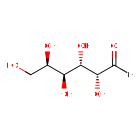
- Mechanism
- Curator reviewed · 11 references
In the development of typhoid Ty21a live oral vaccine, the use of exogenous galactose is critical. When dealing with Salmonella typhimurium, it has been shown that rough strains with incomplete lipopolysaccharide (LPS) lacking O-specific side chains are much less virulent than smooth strains with complete LPS with O-specific side chains. Salmonella typhimurium gal E mutants used to produce the vaccine are effectively avirulent and highly protective but lack the specific UDP-galactose 4-epimerase enzyme which allows for the normal synthesis of UDP-galactose from UDP-glucose. The consequence of this mutant defect is that the gal E mutants can only generate incomplete LPS without O-specific antigen side chains, which are not capable enough as the complete LPS with O-specific side chains at generating an immunologic response. When exogenous galactose is added to the vaccine medium, however, it allows the mutants to generate UDP-galactose via galactose 1-phosphate. This ultimately allows the mutants to form smooth-type LPS with O-specific side chains. Regardless, the mutant's epimerase defect ultimately results in the accumulation of such intermediary products like galactose 1-phosphate and UDP-galactose, which consequently causes lysis of the mutant cells. The resultant vaccine is subsequently effective enough to elicit an immunologic response while the bacteriolysis prevents the mutant cells from regaining virulence under conditions where smooth type LPS similar to the active parental strain is synthesized.
Galactose is also an essential element to the chemical structure of the commonly used laxative solution lactulose. Lactulose itself is a synthetic disaccharide that is made in parts from lactose, galactose, and various other sugars. It is poorly absorbed from the gastrointestinal tract and no enzyme capable of hydrolysis of lactulose is present in human gastrointestinal tissue. Oral doses of lactulose subsequently arrive at the colon largely unchanged. At the colon, lactulose is finally broken down predominantly to lactic acid, and also small amounts of formic and acetic acids by the action of colonic bacteria, which results in an increase in osmotic pressure and slight acidification of the colonic contents. This action consequently causes an increase in stool water content and softens the stool for a laxative effect.
- Primary indication
- There are limited therapeutic uses for which galactose is formally indicated.Curator reviewed
- Formula / weight
- C6H12O6 · 180.1559 g/mol (avg)
- First approval
- Canada, 1998
- Also known as
- D-Galactose
Resolves to
GZCGUPFRVQAUEE-KCDKBNATSA-NSMILES[H]C(=O)[C@H](O)[C@@H](O)[C@@H](O)[C@H](O)COWhat you can answer from here — as of July 07, 2026
Which drugs share a target with Galactose, and which of those have an active Phase 3 trial?
Create a free account or log in to explore the full data card.
Create Account