Nedaplatin is a second generation platinum analog . It is less nephrotoxic than DB00515 but has proven equally effective. It was approved for use in Japan in 1995.
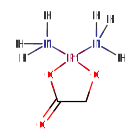
- Mechanism
- Curator reviewed · 2 references
As a platinum analog, nedaplatin likely works similarly to DB00515 on which the following mechanistic description is based. Once it has entered the cell it is hydrolyzed to its active form which complexes with water molecules. This form binds to to nucleophiles in the cytoplasm such as glutathione and other cyteine rich proteins resulting in an overall increase in oxidative stress as the cell loses antioxidant proteins. It also binds to purine nucleotides in the DNA. The active form allows for two binding interactions to form cross-links between these nucleotides. High mobility group proteins-1 and -2 induce apoptosis in response to guanine cross-links and their binding serves to shield the cross-linked DNA from repair mechanisms. The mismatch repair (MMR) protein complex also recognizes the distortion caused by platinum complexes and attempts to repair the DNA. This results in single strand breaks when the MMR complex attempts to remove the platinum cross-link. The MMR complex induces apoptosis after the repair attempt has failed. The single strand break in DNA makes it easier to form lethal double strand breaks with radiation treatment thus creating the radiosensitizing effect of nedaplatin.
- Primary indication
- Used in the treatment of non-small cell lung cancer, small cell lung cancer, oesophygeal cancer, and head and neck cancers.Curator reviewed
- Formula / weight
- C2H8N2O3Pt · 303.181 g/mol (avg)
- Also known as
- CDGP
- Code names
- 254-S · CCRIS 4088 · NSC 375101D
Resolves to
GYAVMUDJCHAASE-UHFFFAOYSA-MSMILES[H][N]([H])([H])[Pt]1(OCC(=O)O1)[N]([H])([H])[H]What you can answer from here — as of February 21, 2021
Which companies are running trials of Nedaplatin, in which indications and phases, and which of those programs are still active?
Create a free account or log in to explore the full data card.
Create Account