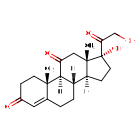
A naturally occurring glucocorticoid. It has been used in replacement therapy for adrenal insufficiency and as an anti-inflammatory agent. Cortisone itself is inactive. It is converted in the liver to... It is converted in the liver to the active metabolite hydrocortisone.
- Mechanism
- Curator reviewed
Pharmacologically active on Phospholipase A2
- Formula / weight
- C21H28O5 · 360.444 g/mol (avg)
- Also known as
- Kendall's compound E · Kortison · Reichstein's substance Fa
Resolves to
Clinical / RWD
Structure
InChIKey
MFYSYFVPBJMHGN-ZPOLXVRWSA-NSMILES[H][C@@]12CC[C@](O)(C(=O)CO)[C@@]1(C)CC(=O)[C@@]1([H])[C@@]2([H])CCC2=CC(=O)CC[C@]12CTargets
What you can answer from here — as of July 10, 2026
1Protein targetEach mapped to UniProt, with action and pharmacological actionListed above
Which drugs share a target with Cortisone, and which of those have an active Phase 3 trial?
Create a free account or log in to explore the full data card.
Create Account