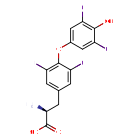
Levothyroxine is a synthetic T4 hormone used to treat hypothyroidism that can be used along with surgery and radioiodine therapy to manage thyrotropin-dependent well-differentiated thyroid cancer. Levothyroxine is a synthetically produced form of thyroxine, a major endogenous hormone secreted by the thyroid gland.
- Mechanism
- Curator reviewed · 8 references
Levothyroxine is a synthetically prepared levo-isomer of the thyroid hormone thyroxine (T4, a tetra-iodinated tyrosine derivative) that acts as a replacement in deficiency syndromes such as hypothyroidism. T4 is the major hormone secreted from the thyroid gland and is chemically identical to the naturally secreted T4: it increases metabolic rate, decreases thyroid-stimulating hormone (TSH) production from the anterior lobe of the pituitary gland, and, in peripheral tissues, is converted to T3. Thyroxine is released from its precursor protein thyroglobulin through proteolysis and secreted into the blood where is it then peripherally deiodinated to form triiodothyronine (T3) which exerts a broad spectrum of stimulatory effects on cell metabolism. T4 and T3 have a relative potency of ~1:4.
Thyroid hormone increases the metabolic rate of cells of all tissues in the body. In the fetus and newborn, thyroid hormone is important for the growth and development of all tissues including bones and the brain. In adults, thyroid hormone helps to maintain brain function, food metabolism, and body temperature, among other effects. The symptoms of thyroid deficiency relieved by levothyroxine include slow speech, lack of energy, weight gain, hair loss, dry thick skin and unusual sensitivity to cold.
The thyroid hormones have been shown to exert both genomic and non-genomic effects. They exert their genomic effects by diffusing into the cell nucleus and binding to thyroid hormone receptors in DNA regions called thyroid hormone response elements (TREs) near genes. This complex of T4, T3, DNA, and other coregulatory proteins causes a conformational change and a resulting shift in transcriptional regulation of nearby genes, synthesis of messenger RNA, and cytoplasmic protein production. For example, in cardiac tissues T3 has been shown to regulate the genes for α- and β-myosin heavy chains, production of the sarcoplasmic reticulum proteins calcium-activated ATPase (Ca2+-ATPase) and phospholamban, β-adrenergic receptors, guanine-nucleotide regulatory proteins, and adenylyl cyclase types V and VI as well as several plasma-membrane ion transporters, such as Na+/K+–ATPase, Na+/Ca2+ exchanger, and voltage-gated potassium channels, including Kv1.5, Kv4.2, and Kv4.3. As a result, many cardiac functions including heart rate, cardiac output, and systemic vascular resistance are closely linked to thyroid status.
The non-genomic actions of the thyroid hormones have been shown to occur through binding to a plasma membrane receptor integrin aVb3 at the Arg-Gly-Asp recognition site. From the cell-surface, T4 binding to integrin results in down-stream effects including activation of mitogen-activated protein kinase (MAPK; ERK1/2) and causes subsequent effects on cellular/nuclear events including angiogenesis and tumor cell proliferation.
- Primary indication
- Levothyroxine is indicated as replacement therapy in primary (thyroidal), secondary (pituitary) and tertiary (hypothalamic) congenital or acquired hypothyroidism.Curator reviewed · 9 structured indications
- Formula / weight
- C15H11I4NO4 · 776.87 g/mol (avg)
- First approval
- Canada, 1998 · United States, 1969
- Also known as
- L-T4 · L-Thyroxine · Levothyroxin · Thyroxine
- Brand names
Resolves to
XUIIKFGFIJCVMT-LBPRGKRZSA-NSMILESN[C@@H](CC1=CC(I)=C(OC2=CC(I)=C(O)C(I)=C2)C(I)=C1)C(O)=OWhat you can answer from here — as of October 06, 2026
Which drugs share a target with Levothyroxine, and which of those have an active Phase 3 trial?
Create a free account or log in to explore the full data card.
Create Account