Glisoxepide is one of the sulphonamide-derived oral antidiabetic drugs. It inhibits the uptake of bile acids into isolated rat hepatocytes. However it inhibits taurocholate uptake only in the absence of... Glisoxepide uptake could be further inhibited by blockers of the hepatocellular monocarboxylate transporter, by the loop diuretic bumetanide, by 4,4'-diisothiocyano-2,2'-stilbenedisulfonate (DIDS) and by sulphate.
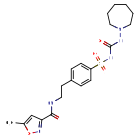
- Mechanism
- Curator reviewed
Glisoxepide is a hypoglycemic sulphonylurea agent. The sulphonylureas are a family of drugs based on a common sulphonylurea core. These drugs act via augmentation of secretion of insulin from pancreatic beta-cells. Sulphonylureas may also cause a reduction in serum glucagon and potentiate the action of insulin at the extrapancreatic tissues. Glisoxepide functions as a non-selective K(ATP) channel blocker. It is thought to stimulate insulin secretion by closing the ATP-sensitive K(+) (K(ATP)) channels (Kir6.2/SUR1 complex, KATP channels) in pancreatic beta-cells. This inhibits a tonic, hyperpolarizing efflux of potassium, thus causing the electric potential over the membrane to become more positive. This depolarization opens voltage-gated Ca2+ channels. The rise in intracellular calcium leads to increased fusion of insulin granulae with the cell membrane, and therefore increased secretion of (pro)insulin.
- Primary indication
- For the treatment of diabetes mellitus type 2.Curator reviewed
- Formula / weight
- C20H27N5O5S · 449.524 g/mol (avg)
- Code names
- BAY-B-4231 · FBB-4231 · RP-22410
Resolves to
ZKUDBRCEOBOWLF-UHFFFAOYSA-NSMILESCC1=CC(=NO1)C(=O)NCCC1=CC=C(C=C1)S(=O)(=O)NC(=O)NN1CCCCCC1What you can answer from here — as of September 23, 2026
Which drugs share a target with Glisoxepide, and which of those have an active Phase 3 trial?
Create a free account or log in to explore the full data card.
Create Account