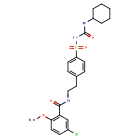
Glyburide is a sulfonylurea used in the treatment of non insulin dependent diabetes mellitus. It is typically given to patients who cannot be managed with the standard first line therapy, metformin.
- Mechanism
- Curator reviewed · 6 references
Glyburide belongs to a class of drugs known as sulfonylureas. These drugs act by closing ATP-sensitive potassium channels on pancreatic beta cells. The ATP-sensitive potassium channels on beta cells are known as sulfonylurea receptor 1 (SUR1).
Under low glucose concentrations, SUR1 remains open, allowing for potassium ion efflux to create a -70mV membrane potential.
Normally SUR1 closes in response to high glucose concentrations, the membrane potential of the cells becomes less negative, the cell depolarizes, voltage gated calcium channels open, calcium ions enter the cell, and the increased intracellular calcium concentration stimulates the release of insulin containing granules.
Glyburide bypasses this process by forcing SUR1 closed and stimulating increased insulin secretion.
- Primary indication
- Glyburide is indicated alone or as part of combination product with metformin, as an adjunct to diet and exercise, to improve glycemic control in adults with type 2 diabetes mellitus.Curator reviewed · 3 structured indications
- Formula / weight
- C23H28ClN3O5S · 494.004 g/mol (avg)
- First approval
- Canada, 1996 · United States, 1984 · European Union, 2021
- Also known as
- Glibenclamide
- Code names
- HB-419 · U-26,45 · U-26,452
- Brand names
Resolves to
ZNNLBTZKUZBEKO-UHFFFAOYSA-NSMILESCOC1=C(C=C(Cl)C=C1)C(=O)NCCC1=CC=C(C=C1)S(=O)(=O)NC(=O)NC1CCCCC1What you can answer from here — as of September 23, 2026
Which drugs share a target with Glyburide, and which of those have an active Phase 3 trial?
Create a free account or log in to explore the full data card.
Create Account