Ethionamide is a second line antitubercular agent used to treat tuberculosis when other treatments have failed. A second-line antitubercular agent that inhibits mycolic acid synthesis.
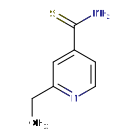
- Mechanism
- Curator reviewed
Ethionamide may be bacteriostatic or bactericidal in action, depending on the concentration of the drug attained at the site of infection and the susceptibility of the infecting organism. Ethionamide, like prothionamide and pyrazinamide, is a nicotinic acid derivative related to isoniazid. It is thought that ethionamide undergoes intracellular modification and acts in a similar fashion to isoniazid. Isoniazid inhibits the synthesis of mycoloic acids, an essential component of the bacterial cell wall. Specifically isoniazid inhibits InhA, the enoyl reductase from Mycobacterium tuberculosis, by forming a covalent adduct with the NAD cofactor. It is the INH-NAD adduct that acts as a slow, tight-binding competitive inhibitor of InhA.
- Primary indication
- For use in the treatment of pulmonary and extrapulmonary tuberculosis when other antitubercular drugs have failed.Curator reviewed · 1 structured indication
- Formula / weight
- C8H10N2S · 166.243 g/mol (avg)
- First approval
- United States, 2004
- Also known as
- Ethinamide · Ethioniamide · Ethylisothiamide · Ethyonomide · Etionamid
- Code names
- 1314-TH · Bayer 5312 · NSC-255115
Resolves to
AEOCXXJPGCBFJA-UHFFFAOYSA-NSMILESCCC1=NC=CC(=C1)C(N)=SWhat you can answer from here — as of September 23, 2026
Which drugs share a target with Ethionamide, and which of those have an active Phase 3 trial?
Create a free account or log in to explore the full data card.
Create Account