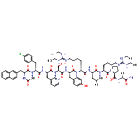
Ganirelix is a GnRH antagonist used in assisted reproduction in women undergoing controlled ovarian hyperstimulation to control ovulation by inhibiting the premature LH surges. Ganirelix is a synthetic decapeptide and a competitive gonadotropin-releasing hormone (GnRH) antagonist.
- Mechanism
- Curator reviewed · 7 references
Gonadotropin-releasing hormone (GnRH) is a hypothalamus-derived releasing hormone responsible for the synthesis and release of luteinizing hormone (LH) and follicle-stimulating hormone (FSH) from the anterior pituitary. At midcycle, a large increase in GnRH release results in an LH surge, which leads to several physiologic actions such as ovulation, resumption of meiosis in the oocyte, and luteinization. Luteinization results in a rise in serum progesterone with an accompanying decrease in estradiol levels.
Controlled ovarian hyperstimulation (COH) is performed in conjunction with other interventions like in vitro fertilization (IVF) during assisted reproductive technology (ART). COH is beneficial as it allows the scheduling of IVF treatments. During this intervention, inhibiting premature surges of LH is important because premature elevated LH levels can hinder effective multiple follicular maturation and can lead to an undesirable increase in progesterone levels. Ganirelix aims to suppress premature LH surges by competitively blocking the GnRH receptors on the pituitary gonadotroph and subsequent transduction pathways. Ganirelix-induced suppression of gonadotropin secretion is rapid and reversible. The suppression of pituitary LH secretion by ganirelix is more pronounced than that of FSH. An initial release of endogenous gonadotropins has not been detected with ganirelix, which is consistent with an antagonist effect.
- Primary indication
- Ganirelix is indicated for the inhibition of premature luteinizing hormone (LH) surges in women undergoing controlled ovarian hyperstimulation for assisted reproduction techniques (ART).Curator reviewed · 1 structured indication
- Formula / weight
- C80H113ClN18O13 · 1570.35 g/mol (avg)
- First approval
- Canada, 2021 · United States, 1999 · European Union, 2016
- Code names
- Org 37462 · RS 26306 · SML0241
- Brand names
Resolves to
GJNXBNATEDXMAK-PFLSVRRQSA-NSMILESCCNC(NCC)=NCCCC[C@@H](NC(=O)[C@H](CC1=CC=C(O)C=C1)NC(=O)[C@H](CO)NC(=O)[C@@H](CC1=CC=CN=C1)NC(=O)[C@@H](CC1=CC=C(Cl)C=C1)NC(=O)[C@@H](CC1=CC2=CC=CC=C2C=C1)NC(C)=O)C(=O)N[C@@H](CC(C)C)C(=O)N[C@@H](CCCCN=C(NCC)NCC)C(=O)N1CCC[C@H]1C(=O)N[C@H](C)C(N)=OWhat you can answer from here — as of September 23, 2026
Which drugs share a target with Ganirelix, and which of those have an active Phase 3 trial?
Create a free account or log in to explore the full data card.
Create Account