Amifampridine is a voltage gated potassium channel blocker used to treat Lambert-Eaton myasthenic syndrome. Amifampridine, or 3,4-diaminopyridine (3,4-DAP), is a quaternary ammonium compound that blocks presynaptic potassium channels, and subsequently prolongs the action potential and increases presynaptic calcium concentrations.
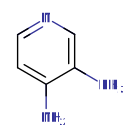
- Mechanism
- Curator reviewed · 3 references
Amifampridine is a symptomatic treatment that increases acetylcholine concentrations at the neuromuscular junction. It selectively blocks presynaptic fast voltage-gated potassium channels, thereby prolonging cell membrane depolarization and action potential, and augmenting calcium transport into the nerve endings. Increased intracellular calcium enhances the exocytosis of acetylcholine-containing vesicles and enhances impulse transmission at central, autonomic, and neuromuscular synapses. Amifampridine improves muscle strength and resting compound muscle action potential (CMAP) amplitudes with an overall weighted mean difference of 1.69 mV.
- Primary indication
- Amifampridine is indicated for the symptomatic treatment of Lambert-Eaton myasthenic syndrome (LEMS) in adults and pediatric patients.Curator reviewed · 2 structured indications
- Formula / weight
- C5H7N3 · 109.132 g/mol (avg)
- First approval
- Canada, 2020 · United States, 2019 · European Union, 2020
- Also known as
- 3,4 diaminopyridine · 3,4-DAP · 3,4-Diaminopyridine · 3,4-Pyridinediamine · 4,5-Diaminopyridine
- Code names
- NSC-521760
- Brand names
Resolves to
OYTKINVCDFNREN-UHFFFAOYSA-NSMILESNC1=CC=NC=C1NWhat you can answer from here — as of September 23, 2026
Which drugs share a target with Amifampridine, and which of those have an active Phase 3 trial?
Create a free account or log in to explore the full data card.
Create Account