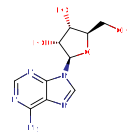
Adenosine is a medication used in myocardial perfusion scintigraphy and to treat supraventricular tachycardia. The structure of adenosine was first described in 1931, though the vasodilating effects were not described in literature until the 1940s.
- Mechanism
- Curator reviewed · 7 references
Agonism of adenosine receptors A1 and A2 reduces conduction time in the atrioventricular node of the heart. Conduction time is decreased by inducing potassium efflux and inhibiting calcium influx through channels in nerve cells, leading to hyperpolarization and and increased threshold for calcium dependent action potentials. Decreased conduction time leads to an antiarrhythmic effect. Inhibition of calcium influx, reduces the activity of adenylate cyclase, relaxing vascular smooth muscle. Relaxed vascular smooth muscle leads to increased blood flow through normal coronary arteries but not stenotic arteries, allowing thallium-201 to be more readily uptaken in normal coronary arteries.
- Primary indication
- Adenosine is indicated as an adjunct to thallium-201 in myocardial perfusion scintigraphy in patients unable to adequately exercise.Curator reviewed · 8 structured indications
- Formula / weight
- C10H13N5O4 · 267.2413 g/mol (avg)
- First approval
- Canada, 2005 · United States, 1989
- Also known as
- Ade-Rib · Adenin riboside · Adenine Deoxyribonucleoside · Adenogesic · beta-D-Adenosine
- Code names
- SR-96225 · USAF CB-10
- Brand names
Resolves to
OIRDTQYFTABQOQ-KQYNXXCUSA-NSMILESNC1=C2N=CN([C@@H]3O[C@H](CO)[C@@H](O)[C@H]3O)C2=NC=N1What you can answer from here — as of September 23, 2026
Which drugs share a target with Adenosine, and which of those have an active Phase 3 trial?
Create a free account or log in to explore the full data card.
Create Account