Chlorothiazide is a thiazide diuretic used to treat hypertension and edema in congestive heart failure, hepatic cirrhosis, and corticosteroid and estrogen therapy. A thiazide diuretic with actions and uses similar to those of hydrochlorothiazide.
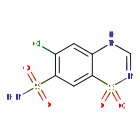
- Mechanism
- Curator reviewed
As a diuretic, chlorothiazide inhibits active chloride reabsorption at the early distal tubule via the Na-Cl cotransporter, resulting in an increase in the excretion of sodium, chloride, and water. Thiazides like chlorothiazide also inhibit sodium ion transport across the renal tubular epithelium through binding to the thiazide sensitive sodium-chloride transporter. This results in an increase in potassium excretion via the sodium-potassium exchange mechanism. The antihypertensive mechanism of chlorothiazide is less well understood although it may be mediated through its action on carbonic anhydrases in the smooth muscle or through its action on the large-conductance calcium-activated potassium (KCa) channel, also found in the smooth muscle.
- Primary indication
- Chlorothiazide is indicated as adjunctive therapy in edema associated with congestive heart failure, hepatic cirrhosis, and corticosteroid and estrogen therapy.Curator reviewed · 2 structured indications
- Formula / weight
- C7H6ClN3O4S2 · 295.723 g/mol (avg)
- First approval
- Canada, 1972 · United States, 1958
- Also known as
- Chlorothiazid · Chlorthiazide
- Brand names
Resolves to
JBMKAUGHUNFTOL-UHFFFAOYSA-NSMILESNS(=O)(=O)C1=C(Cl)C=C2NC=NS(=O)(=O)C2=C1What you can answer from here — as of September 23, 2026
Which drugs share a target with Chlorothiazide, and which of those have an active Phase 3 trial?
Create a free account or log in to explore the full data card.
Create Account