Pimavanserin is a second generation atypical antipsychotic used for the treatment of hallucinations and delusions caused by Parkinson's Disease. Although the exact mechanism of action is unknown, it is thought that pimavanserin interacts with the serotonin receptors, particularly the 5-HT2A and HT2C receptors.
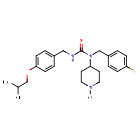
- Mechanism
- Curator reviewed · 3 references
Parkinson's disease psychosis (PDP) is an imbalance of serotonin and dopamine from disruption of the normal balance between the serotonergic and dopaminergic receptors and neurotransmitters in the brain.
The mechanism by which pimavanserin treats hallucinations and delusions associated with Parkinson’s disease psychosis is not fully established. It is possible that pimavanserin acts via inverse agonist and antagonist activity at serotonin 5-HT2A receptors with limited effects on serotonin 5-HT2C receptors. Pimavanserin is an inverse agonist and antagonist of serotonin 5-HT2A receptors with high binding affinity, demonstrating low binding affinity to serotonin 5-HT2C receptors. In addition, this drug exhibits low affinity binding to sigma 1 receptors. Pimavanserin lacks activity at muscarinic, dopaminergic, adrenergic, and histaminergic receptors, preventing various undesirable effects typically associated with antipsychotics.
- Primary indication
- Pimavanserin is indicated for the treatment of hallucinations and delusions associated with Parkinson’s disease psychosis.Curator reviewed · 2 structured indications
- Formula / weight
- C25H34FN3O2 · 427.564 g/mol (avg)
- First approval
- United States, 2016
- Code names
- ACP-103
- Brand names
Resolves to
RKEWSXXUOLRFBX-UHFFFAOYSA-NSMILESCC(C)COC1=CC=C(CNC(=O)N(CC2=CC=C(F)C=C2)C2CCN(C)CC2)C=C1What you can answer from here — as of September 23, 2026
Which drugs share a target with Pimavanserin, and which of those have an active Phase 3 trial?
Create a free account or log in to explore the full data card.
Create Account