Mavacamten is a myosin inhibitor used to treat obstructive hypertrophic cardiomyopathy. It received initial US FDA approval in 2022, and it is one of the first myosin inhibitors to be used in humans.
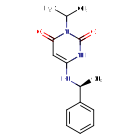
- Mechanism
- Curator reviewed · 17 references
Myosin is a family of enzymes that can produce mechanical output by an ATP-mediated cyclic interaction with actin. When ATP is bound to the myosin head, it is hydrolyzed into ADP and organophosphate by myosin ATPase activity, and the energy produced from the reaction is stored in the myosin head. As the organophosphate dissociates from myosin, it shifts myosin into a strong binding state to actin, thus creating a myosin-actin complex otherwise known as "cross-bridging". Dissociation of the organophosphate also causes a conformation change in myosin that creates strain in the actin-myosin bridge that can only be released once the actin and myosin filaments slide past each other, thus shortening the sarcomere and create a muscle contraction. Once the sliding is completed, ADP is released to create further movement of the myosin head. Although this ADP release-induced movement is minor and unlikely to contribute to the sarcomere movement, researchers have hypothesized that this movement is likely essential in limiting the sliding velocity of actin. Finally, myosin then bind to a new ATP molecule to initiate the chemomechanical cycle again.
Mavacamten reduces sarcomere hypercontractility by acting as an allosteric and reversible modulator of the beta-cardiac isoform of myosin to reduce its ATPase activity, thus reducing actin-myosin cross bridging. Specifically, mavacamten inhibits the phosphate release, the cycle's rate-limiting step, without affecting the ADP release rate in actin-bound myosin. Also, mavacamten inhibits binding of ADP-bound myosin to actin as well as ADP release to prime the myosin head to initiate turnover. Recently, it was also discovered when myosin is not in its active state to interact with actin, it exists in equilibrium between 2 energy sparing states: a disordered relaxed state, where interaction between actin and myosin by the thin filament regulatory proteins, and a super relaxed state, where significant myosin head-to-head interaction lengthen ATP turnover rate.. Mavacamten's binding to myosin can shift the equilibrium toward the super relaxed state, effectively exerting both a basal and actin-activated ATP inhibition.
- Primary indication
- Mavacamten is indicated for the treatment of adults with symptomatic New York Heart Association (NYHA) class II-III obstructive hypertrophic cardiomyopathy (HCM) to improve functional capacity and symptoms by the FDA, Health Canada, and the EMA.Curator reviewed · 4 structured indications
- Formula / weight
- C15H19N3O2 · 273.336 g/mol (avg)
- First approval
- Canada, 2022 · United States, 2022 · European Union, 2023
- Code names
- BMS-986427 · MYK-461 · SAR-439152
- Brand names
Resolves to
RLCLASQCAPXVLM-NSHDSACASA-NSMILESCC(C)N1C(=O)NC(N[C@@H](C)C2=CC=CC=C2)=CC1=OWhat you can answer from here — as of October 20, 2026
Which drugs share a target with Mavacamten, and which of those have an active Phase 3 trial?
Create a free account or log in to explore the full data card.
Create Account