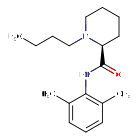
Levobupivacaine is a drug used for nerve block and anesthesia. Levobupivacaine is an amino-amide local anaesthetic drug belonging to the family of n-alkylsubstituted pipecoloxylidide.
- Mechanism
- Curator reviewed
Local anesthetics such as Levobupivacaine block the generation and the conduction of nerve impulses, presumably by increasing the threshold for electrical excitation in the nerve, by slowing the propagation of the nerve impulse, and by reducing the rate of rise of the action potential. In general, the progression of anesthesia is related to the diameter, myelination and conduction velocity of affected nerve fibers. Specifically, the drug binds to the intracellular portion of sodium channels and blocks sodium influx into nerve cells, which prevents depolarization.
- Primary indication
- For the production of local or regional anesthesia for surgery and obstetrics, and for post-operative pain managementCurator reviewed · 4 structured indications
- Formula / weight
- C18H28N2O · 288.4277 g/mol (avg)
- Also known as
- (S)-bupivacaine · L-BUPIVACAINE · levo-bupivacaine
Resolves to
LEBVLXFERQHONN-INIZCTEOSA-NSMILESCCCCN1CCCC[C@H]1C(=O)NC1=C(C)C=CC=C1CWhat you can answer from here — as of September 23, 2026
Which drugs share a target with Levobupivacaine, and which of those have an active Phase 3 trial?
Create a free account or log in to explore the full data card.
Create Account