Methacholine is a parasympathomimetic bronchoconstrictor used to diagnose bronchial hyperreactivity in subjects who do not have clinically apparent asthma. Asthma is a complex condition associated with phenomena such as airway hyperresponsiveness (AHR), in which the smooth muscle in the airways (ASM) excessively contracts in response to stimuli, reducing pulmonary function and causing symptoms such...
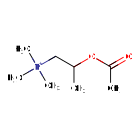
- Mechanism
- Curator reviewed · 19 references
Asthma is a complicated condition associated with airway remodelling, including the proliferation of airway smooth muscle (ASM) and altered extracellular matrix, aberrant pro-inflammatory immune responses, and excessive ASM contraction leading to decreased lung function. Excessive ASM contraction in response to contractile agonists, a phenomenon termed airway hyperresponsiveness (AHR), is a physical manifestation of the altered pulmonary physiology in asthma. Although numerous factors, such as increased ASM levels, pro-contractile molecules, pro-inflammatory cytokines, and growth factors, contribute to AHR, one of the key factors in determining ASM tone is regulated by vagal parasympathetic nerve innervation. The response to acetylcholine and other cholinergic agonists at these neuromuscular junctions is predominantly controlled by inhibitory Gi-coupled M2 and excitatory Gq-coupled M3 muscarinic acetylcholine receptors (mAChRs). Activation of M3 receptors results in ASM contraction and resulting bronchoconstriction through downstream calcium-dependent signalling pathways, while M2 activation inhibits neuronal acetylcholine release.
Methacholine is a non-specific mAChR agonist, capable of acting on all mAChR subtypes. However, in the context of AHR, methacholine's ability to induce bronchoconstriction through M3 receptors is clinically relevant. In addition, M3 agonism may increase the release of pro-inflammatory cytokines, further contributing to AHR. The inhibitory effect of M2 agonism by methacholine is likely also important, as shown by animal studies using mice with impaired M2 function, and by observations that eosinophilic inflammation, such as occurs in asthma, negatively impacts M2 function. Hence, asthmatic patients are more sensitive to inhaled cholinergic agonists such as methacholine; this forms the basis for the methacholine challenge test, which diagnoses AHR through an increased methacholine-induced response.
- Primary indication
- Methacholine is indicated in adult and pediatric patients aged five years and older without clinically apparent asthma for the diagnosis of bronchial airway hyperactivity via the methacholine challenge test.Curator reviewed · 1 structured indication
- Formula / weight
- C8H18NO2 · 160.234 g/mol (avg)
- First approval
- Canada, 1999 · United States, 2013
- Also known as
- Acetyl-beta-methylcholine · Acetylmethylcholine · beta-Methylacetylcholine
- Brand names
Resolves to
NZWOPGCLSHLLPA-UHFFFAOYSA-NSMILESCC(C[N+](C)(C)C)OC(C)=OWhat you can answer from here — as of September 23, 2026
Which drugs share a target with Methacholine, and which of those have an active Phase 3 trial?
Create a free account or log in to explore the full data card.
Create Account