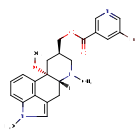
Nicergoline is an ergot derivative use for the treatment of symptoms associated with cerebrovascular abnormalities. An ergot derivative that has been used as a cerebral vasodilator and in peripheral vascular disease.
- Mechanism
- Curator reviewed
Nicergoline acts by inhibiting the postsynaptic alpha(1)-adrenoceptors on vascular smooth muscle. This inhibits the vasoconstrictor effect of circulating and locally released catecholamines (epinephrine and norepinephrine), resulting in peripheral vasodilation. Therefore the mechanism of Nicergoline is to increase vascular circulation in the brain, thereby enhancing the transmission of nerve signals across the nerve fibres, which secrete acetylcholine as a neural transmitter.
- Primary indication
- For the treatment of senile dementia, migraines of vascular origin, transient ischemia, platelet hyper-aggregability, and macular degeneration.Curator reviewed · 3 structured indications
- Formula / weight
- C24H26BrN3O3 · 484.386 g/mol (avg)
- Code names
- FI-6714
Resolves to
YSEXMKHXIOCEJA-FVFQAYNVSA-NSMILES[H][C@@]12CC3=CN(C)C4=CC=CC(=C34)[C@]1(C[C@@H](COC(=O)C1=CN=CC(Br)=C1)CN2C)OCWhat you can answer from here — as of September 23, 2026
Which drugs share a target with Nicergoline, and which of those have an active Phase 3 trial?
Create a free account or log in to explore the full data card.
Create Account