Tenofovir is a nucleotide analog indicated in the treatment of HIV infections. In the most strict sense and due to the fact that it presents a phosphate group bound to the nitrogenous base, it is determined as an actual nucleotide analog.
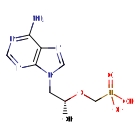
- Mechanism
- Curator reviewed · 4 references
Once tenofovir is activated by a bi-phosphorylation it acts as an antiviral acyclic nucleoside phosphonate. It is a potent inhibitor of the viral reverse transcriptase with an inhibitory constant of approximately 0.022 micromolar.
Once activated, tenofovir acts with different mechanisms including the inhibition of viral polymerase causing chain termination and the inhibition of viral synthesis. All these activities are attained by its competition with deoxyadenosine 5'-triphosphate in the generation of new viral DNA. Once tenofovir is incorporated in the chain, it induces a chain termination which in order inhibits viral replication. The safety of tenofovir relies on its low affinity towards the cellular DNA polymerase including the mitochondrial DNA polymerase gamma.
- Primary indication
- Tenofovir has been shown to be effective against HIV, herpes simplex virus-2, and hepatitis B virus.Curator reviewed
- Formula / weight
- C9H14N5O4P · 287.2123 g/mol (avg)
- Also known as
- (R)-PMPA · Tenofovir (anh.)
- Code names
- GS-1275
Resolves to
SGOIRFVFHAKUTI-ZCFIWIBFSA-NSMILESC[C@H](CN1C=NC2=C1N=CN=C2N)OCP(O)(O)=OWhat you can answer from here — as of September 23, 2026
Which drugs share a target with Tenofovir, and which of those have an active Phase 3 trial?
Create a free account or log in to explore the full data card.
Create Account