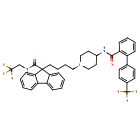
Lomitapide is a microsomal triglyceride transfer protein inhibitor used to lower cholesterol associated with homozygous familial hypercholesterolemia (HoFH), reducing risk of cardiovascular events such as myocardial infarction and stroke. Lomitapide, marketed under the brand names Juxtapid (USA) and Lojuxta (EU), is a first-in-class, small-molecule inhibitor of microsomal triglyceride transfer protein (MTP).
- Mechanism
- Curator reviewed · 13 references
Lomitapide works at the molecular level as a selective, small-molecule inhibitor of microsomal triglyceride transfer protein (MTP). MTP is a critical chaperone protein located within the lumen of the endoplasmic reticulum in hepatocytes (liver cells) and enterocytes (intestinal cells). Its primary function is to facilitate the transfer of triglycerides, phospholipids, and cholesteryl esters onto apolipoprotein B (apo B) to form nascent lipoprotein particles.
Specifically, in the intestine, MTP is required for the assembly of chylomicrons, while in the liver, it is essential for the production of very low-density lipoproteins (VLDL). By directly binding to and inhibiting MTP, lomitapide prevents the lipid loading of apo B-48 (in the gut) and apo B-100 (in the liver). This blockade results in a significant reduction in the secretion of VLDL into the bloodstream; since LDL is a metabolic byproduct of VLDL, this leads to a secondary and substantial decrease in circulating LDL-C levels. This mechanism is particularly important for HoFH patients, as it functions independently of the LDL receptor, which is typically defective or absent in this population.
- Primary indication
- Lomitapide is indicated as an adjunct to a low-fat diet and exercise and other low density lipoprotein cholesterol (LDL-C) therapies to reduce LDL-C in adults and pediatric patients aged two years and older with homozygous...Curator reviewed · 1 structured indication
- Formula / weight
- C39H37F6N3O2 · 693.7204 g/mol (avg)
- First approval
- Canada, 2024 · United States, 2013 · European Union, 2021
- Also known as
- 9H-FLUORENE-9-CARBOXAMIDE, N-(2,2,2-TRIFLUOROETHYL)-9-(4-(4-(((4'-(TRIFLUOROMETHYL)(1,1'-BIPHENYL)-2-YL)CARBONYL)AMINO)-1-PIPERIDINYL)BUTYL)- · N-(2,2,2-TRIFLUOROETHYL)-9-(4-(4-(((4'-(TRIFLUOROMETHYL)BIPHENYL-2-YL)CARBONYL)AMINO)PIPERIDIN-1-YL)BUTYL)-9H-FLUORENE-9-CARBOXAMIDE
- Code names
- AEGR-733 · AEGR-773 · BMS 201038 · BMS-201038-01 · BMS-201038-04
- Brand names
Resolves to
MBBCVAKAJPKAKM-UHFFFAOYSA-NSMILESFC(F)(F)CNC(=O)C1(CCCCN2CCC(CC2)NC(=O)C2=C(C=CC=C2)C2=CC=C(C=C2)C(F)(F)F)C2=CC=CC=C2C2=CC=CC=C12What you can answer from here — as of September 23, 2026
Which drugs share a target with Lomitapide, and which of those have an active Phase 3 trial?
Create a free account or log in to explore the full data card.
Create Account