Selpercatinib is a RET receptor tyrosine kinase inhibitor for the treatment of RET-driven non-small cell lung cancer, medullary thyroid cancer, and thyroid cancer in appropriate patient populations. Selpercatinib is a kinase inhibitor with enhanced specificity for RET tyrosine kinase receptors (RTKs) over other RTK classes.
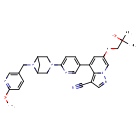
- Mechanism
- Curator reviewed · 9 references
Rearranged during transfection (RET) is a transmembrane receptor tyrosine kinase containing extracellular, transmembrane, and intracellular domains whose activity is required for normal kidney and nervous system development. Constitutive RET activation is primarily achieved through chromosomal rearrangements producing 5' fusions of dimerizable domains to the 3' RET tyrosine kinase domain, such as KIF5B-RET and CCDC6-RET, resulting in constitutive dimerization and subsequent autophosphorylation. Constitutive activation leads to increased downstream signalling and is associated with tumour invasion, migration, and proliferation.
Selpercatinib is a direct RET kinase inhibitor, exhibiting IC50 values between 0.92 and 67.8 nM depending on the exact RET genotype. Information based on natural as well as induced resistance mutations and molecular modelling suggests that selpercatinib directly inhibits RET autophosphorylation by competing with ATP for binding. Various single amino acid mutations at position 810 inhibit selpercatinib binding without significantly altering ATP binding, potentially leading to treatment failures.
Selpercatinib is also reported to inhibit other tyrosine kinase receptors, including VEGFR1, VEGFR3, FGFR1, FGFR2, and FGFR3, at clinically relevant concentrations. The significance of these effects is not well studied.
- Primary indication
- Selpercatinib is approved to treat: adult with locally advanced or metastatic non-small cell lung cancer (NSCLC) with a rearranged during transfection (RET) gene fusion.Curator reviewed · 13 structured indications
- Formula / weight
- C29H31N7O3 · 525.613 g/mol (avg)
- First approval
- Canada, 2025 · United States, 2020 · European Union, 2021
- Code names
- LOXO-292 · LY-3527723 · WHO 10967
- Brand names
Resolves to
XIIOFHFUYBLOLW-UHFFFAOYSA-NSMILESCOC1=NC=C(CN2C3CC2CN(C3)C2=CC=C(C=N2)C2=CC(OCC(C)(C)O)=CN3N=CC(C#N)=C23)C=C1What you can answer from here — as of September 23, 2026
Which drugs share a target with Selpercatinib, and which of those have an active Phase 3 trial?
Create a free account or log in to explore the full data card.
Create Account