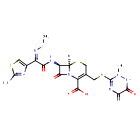
Ceftriaxone is a broad-spectrum cephalosporin antibiotic used for the treatment of bacterial infections in various locations, such as in the respiratory tract, skin, soft tissue, and urinary tract. It has a very long half-life compared to other cephalosporins and is high penetrable into the meninges, eyes, and inner ear.
- Mechanism
- Curator reviewed · 2 references
Ceftriaxone works by inhibiting the mucopeptide synthesis in the bacterial cell wall. The beta-lactam moiety of ceftriaxone binds to carboxypeptidases, endopeptidases, and transpeptidases in the bacterial cytoplasmic membrane. These enzymes are involved in cell-wall synthesis and cell division. Binding of ceftriaxone to these enzymes causes the enzyme to lose activity; therefore, the bacteria produce defective cell walls, causing cell death.
- Primary indication
- Ceftriaxone is used for the treatment of the infections (respiratory, skin, soft tissue, UTI, ENT) caused by susceptible organisms.Curator reviewed · 35 structured indications
- Formula / weight
- C18H18N8O7S3 · 554.58 g/mol (avg)
- First approval
- Canada, 2006 · United States, 1993
- Also known as
- Rocephin
- Code names
- DRG-0071 · Ro 139904
- Brand names
Resolves to
VAAUVRVFOQPIGI-SPQHTLEESA-NSMILES[H][C@]12SCC(CSC3=NC(=O)C(=O)NN3C)=C(N1C(=O)[C@H]2NC(=O)C(=N/OC)\C1=CSC(N)=N1)C(O)=OWhat you can answer from here — as of September 23, 2026
Which drugs share a target with Ceftriaxone, and which of those have an active Phase 3 trial?
Create a free account or log in to explore the full data card.
Create Account