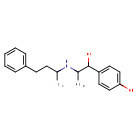
Nylidrin is a vasodilator used to treat patients with peripheral vascular disorders, and elderly patients with symptoms associated with organic mental disorders. Nylidrin, also known as buphenine belongs to the category of drugs called vasodilators, which relax blood vessels and increase blood flow.
- Mechanism
- Curator reviewed · 6 references
This drug is classified as a beta receptor agonist.The β2-adrenergic receptor belongs to the widely expressed 7-transmembrane receptors superfamily, which signals through heterotrimeric G-proteins. They are frequently referred to as G-protein-coupled receptors because they accomplish signal transduction to the interior of the cell by interactions with guanine nucleotide regulatory binding proteins. The receptor-coupled G-proteins work as “molecular switches” which alternate from an inactive guanosine-diphosphate to an active guanosine-triphosphate (GTP) state, which then act to modulate all downstream cell processes. Signaling by various hormones and neurotransmitters, as well as photons and odors, follows the same general pathway, (i.e., by binding of an extracellular ligand to the receptor, which then interacts with the membrane-bound G-protein). This complex, often referred to as the ternary complex, then acts through the activated G-protein to regulate an effector, such as adenylyl cyclase, phospholipase C, or ion channels.
The main effects of Nylidrin may be divided into 3 categories:
Blood vessels
Vascular smooth muscle has β2-adrenoceptors that have a high binding affinity for circulating epinephrine and a lower affinity to norepinephrine released by sympathetic adrenergic nerves. When nylidrin binds to the beta-adrenergic receptors, it prevents the binding of epinephrine, leading to decreased blood vessel contractility as epinephrine is unable to bind.
Heart:
Increased intracellular cAMP by beta-2-agonists inhibits myosin light chain kinase, leading to relaxation These receptors, like the receptors in the heart, are coupled to a Gs-protein, which acts stimulate the formation of cAMP. Although increased cAMP increases cardiac myocyte contraction, in vascular smooth muscle, an increase in cAMP causes smooth muscle relaxation. The reason for this is the fact that cAMP inhibits myosin light chain kinase that is responsible for phosphorylating smooth muscle myosin. Increases in intracellular cAMP caused by β2-agonists inhibit myosin light chain kinase thereby producing less contractile force (i.e., promoting relaxation).
Other tissues
Activation of β2-adrenoceptors in the lungs causes bronchodilation. β2-adrenoceptor activation leads to hepatic glycogenolysis and the pancreatic secretion of glucagon, increasing plasma glucose concentrations. β1-adrenoceptor stimulation in the kidneys promotes the release of renin, stimulating the production of angiotensin II and the subsequent release of aldosterone by the adrenal cortex.
- Primary indication
- Nylidrin is mainly indicated in conditions like arteriosclerosis, cerebrovascular disease, peripheral vascular disease, Raynaud's disease, thrombo-angitis obliterans, and thrombophlebitis.Curator reviewed
- Formula / weight
- C19H25NO2 · 299.414 g/mol (avg)
- First approval
- Canada, 2000
- Also known as
- Buphenin · Buphenine
- Code names
- CS 6712 · SKF 1700-A
Resolves to
PTGXAUBQBSGPKF-UHFFFAOYSA-NSMILESCC(CCC1=CC=CC=C1)NC(C)C(O)C1=CC=C(O)C=C1What you can answer from here — as of October 24, 2026
Which drugs share a target with Nylidrin, and which of those have an active Phase 3 trial?
Create a free account or log in to explore the full data card.
Create Account