Macitentan is an endothelin receptor antagonist used to manage pulmonary arterial hypertension to delay disease progression. It was first approved by the FDA in 2013.
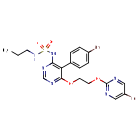
- Mechanism
- Curator reviewed · 8 references
Macitentan is an antagonist which binds to the endothelin A and B receptors (EA and EB) and blocks signaling from endothelin-1 and -2. Pulmonary arterial hypertension has many different mechanisms which contribute to the development of endothelial dysfunction including elevated cytosolic calcium, genetic factors, epigenetic changes, and mitochondrial dysfunction. The focus of macitentan's mechanism relates to the role of overexpressed endothelin from the vascular endothelium. Endothelins are released in both a constitutive fashion from secretory vesicles and in response to stimuli via Weibel-Palade storage granules. Endothelins bind to the EA and EB receptors, with endothelins -1 and -2 having more affinity than endothelin-3. Binding to the Gq coupled EA receptor triggers Ca2+ release from the sarcoplasmic reticulum of smooth muscle cells via the phospholipase C (PLC) pathway. Downstream protein kinase C activation may also contribute to increased Ca2+ sensitivity of the contractile apparatus. EA receptor activation is also known to contribute to pulmonary artery smooth muscle cell proliferation. The binding of endothelins to the EB receptors acts in opposition to EA signaling by activating the same PLC cascade in endothelial cells to activate endothelial nitric oxide synthase. The subsequent release of nitric oxide produces vasodilation through the cyclic guanosine monophosphate cascade. Despite the greater presence of EB receptors on endothelial cells, they are still present on smooth muscle cells and may contribute to cell proliferation through the same mechanisms as EA receptors. Macitentan is thought to provide its therapeutic effect primarily via blocking signaling through EA which produces both decreased vasoconstriction via reduced smooth muscle cell contractility and attenuation of the hyperproliferation of smooth muscle cells found in PAH. Blockade of EB is less likely to contribute to a therapeutic effect as this signaling is responsible for the counter-regulatory vasodilatory signal.
- Primary indication
- Macitentan, alone or in combination with tadalafil, is indicated for the treatment of pulmonary arterial hypertension (PAH; WHO Group 1) in adult patients of WHO functional class II to III.Curator reviewed · 3 structured indications
- Formula / weight
- C19H20Br2N6O4S · 588.273 g/mol (avg)
- First approval
- Canada, 2018 · United States, 2013 · European Union, 2020
- Code names
- ACT-064992 · JNJ-67896062
- Brand names
Resolves to
JGCMEBMXRHSZKX-UHFFFAOYSA-NSMILESCCCNS(=O)(=O)NC1=C(C(OCCOC2=NC=C(Br)C=N2)=NC=N1)C1=CC=C(Br)C=C1What you can answer from here — as of May 26, 2026
Which drugs share a target with Macitentan, and which of those have an active Phase 3 trial?
Create a free account or log in to explore the full data card.
Create Account