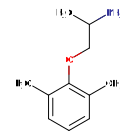
Mexiletine is a class 1B antiarrhythmic agent used in the treatment of documented ventricular arrhythmias that warrant treatment. Antiarrhythmic agent pharmacologically similar to lidocaine.
- Mechanism
- Curator reviewed
Mexiletine, like lidocaine, inhibits the inward sodium current required for the initiation and conduction of impulses, thus reducing the rate of rise of the action potential, Phase 0. It achieves this reduced sodium current by inhibiting sodium channels. Mexiletine decreases the effective refractory period (ERP) in Purkinje fibers in the heart. The decrease in ERP is of lesser magnitude than the decrease in action potential duration (APD), which results in an increase in the ERP/APD ratio. It does not significantly affect resting membrane potential or sinus node automaticity, left ventricular function, systolic arterial blood pressure, atrioventricular (AV) conduction velocity, or QRS or QT intervals
- Primary indication
- For the treatment of ventricular tachycardia and symptomatic premature ventricular beats, and prevention of ventricular fibrillation.Curator reviewed · 2 structured indications
- Formula / weight
- C11H17NO · 179.2588 g/mol (avg)
- First approval
- Canada, 1997 · United States, 1985 · European Union, 2021
- Code names
- Kö 1173
- Brand names
Resolves to
VLPIATFUUWWMKC-UHFFFAOYSA-NSMILESCC(N)COC1=C(C)C=CC=C1CWhat you can answer from here — as of September 23, 2026
Which drugs share a target with Mexiletine, and which of those have an active Phase 3 trial?
Create a free account or log in to explore the full data card.
Create Account