Vinorelbine is a vinca alkaloid used in the treatment of metastatic non-small cell lung carcinoma (NSLC) and in conjunction with other drugs in locally advanced NSCLC. Vinorelbine is an anti-mitotic chemotherapy drug that is used in the treatment of several types of malignancies, including breast cancer and non-small cell lung cancer (NSCLC).
- Mechanism
- Curator reviewed · 7 references
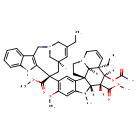
Vinca alkaloids are structurally similar compounds composed of two multi-ringed units, vindoline, and catharanthine. Vinorelbine tartrate is a vinca alkaloid in which the catharanthine component is the target of structural modification.
This structural modification contributes to unique pharmacologic properties.The antitumor activity of vinorelbine tartrate is believed to be owed to the inhibition of mitosis at metaphase via its interaction with tubulin.
Vinorelbine is a mitotic spindle poison that interferes with chromosomal segregation during mitosis, also known as cell division. It pauses cells at the G2/M phases, when present at concentrations close to the half maximal inhibitory concentration (IC50). Microtubules, which are derived from polymers of tubulin, are the main target of vinorelbine.
The chemical modification used to produce vinorelbine allows for the opening of the eight-member catharanthine ring with the formation of both a covalent and reversible bond with tubulin.
The relative contribution of different microtubule-associated proteins in the production of tubulin vary between neural tissue and proliferating cells and this has important functional implications. The ability of vinorelbine to bind specifically to mitotic rather than other microtubules has been shown and may suggest that neurotoxicity is less likely to be a problem than with the molecular mechanism of action.
As with other anti-microtubule agents, vinorelbine is known to contribute apoptosis in malignant cells. The exact mechanisms by which this process occurs are complex and many details are yet to be elucidated. The disarray of the microtubule structure has a number of effects, including the induction of tumor suppressor gene p53 and activation/inactivation of a number of protein kinases involved in essential signaling pathways, including p21 WAF1/CIP1 and Ras/Raf, PKC/PKA. These molecular changes lead to phosphorylation and consequently inactivation of the apoptosis inhibitor Bcl2. This, in turn, results in a decrease in the formation of heterodimers between Bcl2 and the pro-apoptotic gene BAX, stimulating the sequence of cell apoptosis.
Vinorelbine tartrate also possibly interferes with amino acid, cyclic AMP and glutathione metabolism, calmodulin-dependent Ca++-transport ATPase activity, cellular respiration, and nucleic acid and lipid biosynthesis.
- Primary indication
- Vinorelbine tartrate is indicated for adults in the treatment of advanced non-small cell lung cancer (NSCLC), as a single therapy or in combination with other chemotherapeutic drugs.Curator reviewed · 7 structured indications
- Formula / weight
- C45H54N4O8 · 778.947 g/mol (avg)
- First approval
- Canada, 2005 · United States, 2003
- Also known as
- 5'-Noranhydrovinblastine
- Code names
- KW 2307 base
Resolves to
GBABOYUKABKIAF-IELIFDKJSA-NSMILES[H][C@@]12N(C)C3=CC(OC)=C(C=C3[C@@]11CCN3CC=C[C@](CC)([C@@]13[H])[C@@]([H])(OC(C)=O)[C@]2(O)C(=O)OC)[C@]1(C[C@@]2([H])CN(CC(CC)=C2)CC2=C1NC1=CC=CC=C21)C(=O)OCWhat you can answer from here — as of September 23, 2026
Which drugs share a target with Vinorelbine, and which of those have an active Phase 3 trial?
Create a free account or log in to explore the full data card.
Create Account