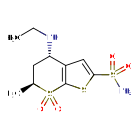
Dorzolamide is a carbonic anhydrase inhibitor used to treat high intraocular pressure in ocular hypertension and open angle glaucoma. It works by blocking an enzyme in the ciliary process that regulates ion balance and fluid pressure in the eyes.
- Mechanism
- Curator reviewed · 7 references
Elevated intraocular pressure is a characteristic manifestation of ocular hypertension or open-angle glaucoma. The level of intraocular pressure (IOP) is governed by the balance between the production of aqueous humour (by ocular ciliary processes) and its outflow from the anterior segment of the eye via trabecular (conventional) or uveoscleral (unconventional) pathways. When there is an increase in the resistance to the trabecular outflow of aqueous humour, the intraocular pressure is elevated. Subsequently, optic nerve damage can occur from blood flow restrictions and mechanical distortion of ocular structures. Optic nerve damage can further result in optic disc cupping and progressive visual field loss (and blindness in some cases).
Carbonic anhydrase (CA) is a ubiquitous enzyme that catalyzes the reversible hydration of carbon dioxide to bicarbonate ions and dehydration of carbonic acid. In the ocular ciliary processes, the local production of bicarbonate by CAs promotes sodium and fluid transport. CA-II is a key isoenzyme found primarily in red blood cells (RBCs) that regulates aqueous humour production. Dorzolamide is a highly specific CA-II inhibitor, where it displays a 4000-fold higher affinity for carbonic anhydrase II than carbonic anhydrase I. The inhibition of CA-II in the ciliary process disrupts the formation of bicarbonate ions and reduces sodium and fluid transport, which leads to decreased aqueous humour secretion and reduced intraocular pressure.
- Primary indication
- Dorzolamide is indicated for the management of elevated intraocular pressure in patients with ocular hypertension or open-angle glaucoma.Curator reviewed · 6 structured indications
- Formula / weight
- C10H16N2O4S3 · 324.44 g/mol (avg)
- First approval
- Canada, 2010 · United States, 1994
- Also known as
- 4S,6S-dorzolamide
- Code names
- L 671152 · MK 507
- Brand names
Resolves to
IAVUPMFITXYVAF-XPUUQOCRSA-NSMILESCCN[C@H]1C[C@H](C)S(=O)(=O)C2=C1C=C(S2)S(N)(=O)=OWhat you can answer from here — as of September 23, 2026
Which drugs share a target with Dorzolamide, and which of those have an active Phase 3 trial?
Create a free account or log in to explore the full data card.
Create Account