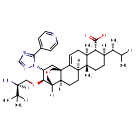
Ibrexafungerp is a triterpene antifungal indicated in the treatment of vulvovaginal candidiasis and prevention of recurrent vulvovaginal candidiasis in post-menarchal patients. It was developed out of a need to treat fungal infections that may have become resistant to echinocandins or azole antifungals.
- Mechanism
- Curator reviewed · 8 references
β-1,3-glucan synthase is composed of a catalytic subunit, FKS1 or FKS2, and a GTP-binding regulatory subunit, Rho1. This synthase is involved in the synthesis of β-1,3-glucan, a fungal cell wall component.
Ibrexafungerp acts similarly to the echinocandin antifungals, by inhibiting the synthesis of β-1,3-glucan synthase. While echinocandins bind to the FKS1 domain of β-1,3-glucan synthase, enfumafungin and its derivatives bind at an alternate site which allows them to maintain their activity against fungal infections that are resistant to echinocandins.
Ibrexafungerp has been shown in animal studies to distribute well to vaginal tissue, making it a favourable treatment for vulvovaginal candidiasis.
- Primary indication
- Ibrexafungerp is indicated in the treatment of vulvovaginal candidiasis in post-menarchal patients.Curator reviewed · 2 structured indications
- Formula / weight
- C44H67N5O4 · 730.051 g/mol (avg)
- First approval
- United States, 2021
- Also known as
- (1S,4AR,6AS,7R,8R,10AR,10BR,12AR,14R,15R)-15-((2R)- 2-AMINO-2,3,3-TRIMETHYLBUTOXY)-1,6A,8,10A-TETRAMETHYL-8- ((2R)-3-METHYLBUTAN-2-YL)-14-(5-(PYRIDIN-4-YL)-1H-1,2,4- TRIAZOL-1-YL)-1,6,6A,7,8,9,10,10A,10B,11,12,12A-DODECAHYDRO-2H,4H-1,4A-PROPANOPHENANTHRO · enfumafungin derivative B-(1,3)-D-glucan synthestis inhibitor
- Code names
- MK-3118 · SCY-078 · WHO 10597
- Brand names
Resolves to
BODYFEUFKHPRCK-ZCZMVWJSSA-NSMILES[H][C@]12CC[C@@]3([H])[C@@]4(C)COC[C@@]3(C[C@H]([C@@H]4OC[C@](C)(N)C(C)(C)C)N3N=CN=C3C3=CC=NC=C3)C1=CC[C@@]1(C)[C@H](C(O)=O)[C@](C)(CC[C@]21C)[C@H](C)C(C)CWhat you can answer from here — as of September 23, 2026
Which drugs share a target with Ibrexafungerp, and which of those have an active Phase 3 trial?
Create a free account or log in to explore the full data card.
Create Account